
I want to tell you about a conversation I had with a senior manager in a financial services firm.
He had been with the organization for eleven years. Deeply loyal. Deeply trusted. The kind of person whose name comes up in every succession planning conversation. When I asked him what he was working on that excited him, he paused for a long moment.
Then he said, “I’m not sure anything does anymore.”
He wasn’t disengaged. He wasn’t burned out. He was something more dangerous than both.
He was obsolete… and he knew it… and nobody in the organization had done anything about it.
Six months later, he left. Not for a competitor. For a startup that promised him something his eleven years of loyalty had never delivered.
A chance to learn something new.
The Uncomfortable Science of Skill Decay
Here is a fact that most retention strategies are not built around.
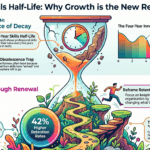
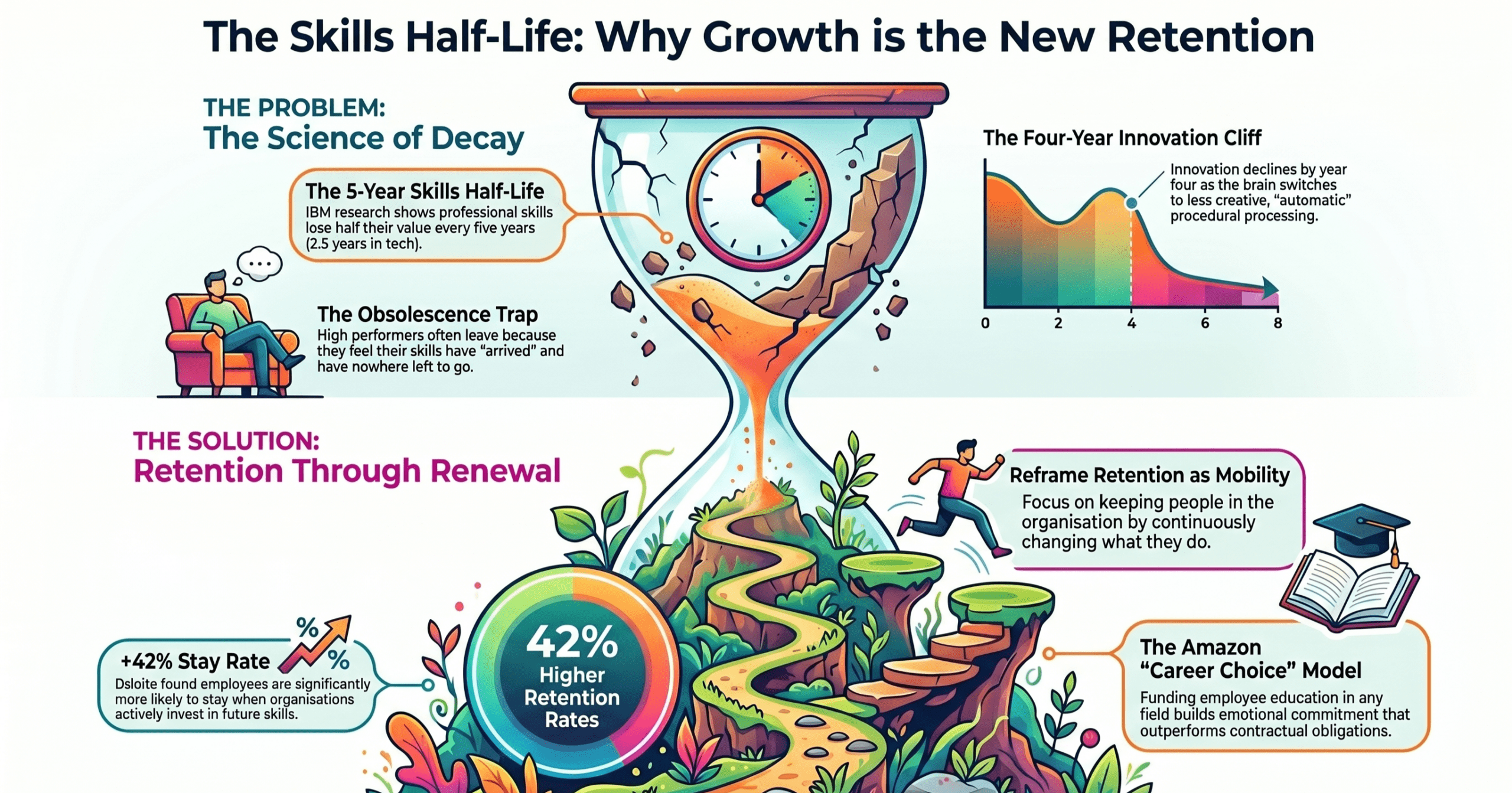
IBM research suggests that the half-life of a professional skill in fast-moving industries is now under five years. In technology-adjacent roles, some researchers place it closer to two and a half. What that means in plain language is this – the knowledge and capability that made someone valuable when you hired them may be contributing significantly less to organizational outcomes five years later… even if the person is working just as hard.
This is not a performance problem. It is a physics problem.
Radioactive decay is a useful metaphor here. Every radioactive element has a half-life… the time it takes for half of its mass to decay into something else. The element doesn’t disappear. It transforms. But if you are expecting it to behave the way it did on day one, you will be consistently disappointed.
Skills work the same way. The Java developer whose expertise was cutting-edge in 2018. The finance professional whose excel-based modeling was state of the art in 2019. The HR leader whose talent management frameworks predate the post-pandemic workforce shift. None of these people became less intelligent or less hardworking. Their skills simply crossed a half-life threshold that the organization never tracked and never addressed.
And here is the part that matters for attrition.
They felt it happening. Long before anyone else did.
The Retention Paradox Nobody Is Talking About
Most organizations design retention strategies around two levers. Compensation and comfort.
Keep salaries competitive. Build a pleasant culture. Create stability. Make people feel settled.
These are not wrong. But they are dangerously incomplete.
Because what keeps a high performer is not just comfort. It is growth. And growth requires the continuous renewal of skill… which requires the organization to actively invest in making its own people’s current capabilities partially obsolete before the market does it for them.
This is a counterintuitive idea. And most organizations flinch at it.
The logic goes like this. If I upskill my people, they become more marketable. If they become more marketable, they might leave. Therefore, better to keep them comfortable and not accidentally make them more attractive to competitors.
This logic is exactly backwards.
Deloitte’s 2023 Global Human Capital Trends report found that employees who feel their organization actively invests in their future skill development are 42% more likely to stay beyond three years. Not less likely to stay. More likely. Because the act of investing in someone’s future is itself a form of organizational commitment. It signals that the organization sees a future for this person beyond their current role.
The organizations that fear upskilling their people are the ones watching those same people leave anyway… just without the new skills, and therefore with a longer recovery time for the organization itself.
What the Bhagavad Gita Says About This (Stay With Me)
In Chapter 2, Verse 47, Krishna tells Arjuna : Karmanye vadhikaraste, ma phaleshu kadachana.
You have the right to perform your duties. Not to the fruits of your actions.
I think about this verse often in the context of organizational learning. Because what it captures, at its philosophical core, is the discipline of continuous action without attachment to the current form of that action.
The warrior who clings to yesterday’s battle strategy will lose tomorrow’s war. The organization that clings to yesterday’s capability architecture will lose tomorrow’s talent.
The half-life of skills is not a threat to be managed. It is an invitation to build organizations that are structurally oriented toward renewal rather than preservation. Organizations that understand this – that the job is never to protect what exists, but to continuously grow what is possible – are the ones that retain people not through comfort alone but through meaning.
And meaning, it turns out, has a much longer half-life than any technical skill.
The Four-Year Cliff
There is a specific data point from Microsoft Viva’s workforce analytics that deserves more attention than it gets in HR circles.
Productivity and innovation contribution from employees in the same role show a measurable decline beginning around year four, not year ten, as most leaders assume. The cliff is not at the end of a long career in one role. It is surprisingly early. And it is not caused by laziness or attitude. It is caused by cognitive automaticity.
By year four in a role, most of what a person does has become procedural. The brain has optimized. Decisions that once required active thinking now happen on autopilot. This is efficient for execution. It is fatal for innovation.
The neuroscience here is straightforward. The prefrontal cortex : the seat of creativity, problem-solving, and novel thinking – is most active when encountering unfamiliar challenges. Once a challenge becomes familiar, the brain reroutes processing to more automatic, less energy-intensive pathways. The person becomes faster and more reliable… and simultaneously less generative.
This is not a character flaw. It is biology. And the organizational response to biology cannot be a performance improvement plan.
The organizational response has to be deliberate role reinvention… new challenges, new contexts, new skill domains introduced before the four-year cliff arrives, not after the resignation letter does.
What Retention Actually Means Now
I want to offer a reframe.
Retention is not about keeping people in their current roles. It is about keeping people in their current organization while continuously changing what they do within it.
The most successful organizations in the next decade will not be the ones with the lowest attrition numbers. They will be the ones that make internal mobility so compelling, so structurally accessible, and so richly supported by learning infrastructure… that leaving to grow somewhere else stops being the default answer.
Amazon calls this “Career Choice.” They fund education for employees in fields that may have nothing to do with their current role at Amazon, including fields where the skills might eventually take that person to a competitor. The philosophy is deliberate. Invest in people’s growth so completely that they feel obligated… not contractually, but emotionally… to stay long enough to become something new inside the same organization.
This is not altruism. It is strategy. And the data backs it up consistently.
The Question Worth Sitting With
Here is what I ask every leadership team I work with when the conversation turns to attrition.
When was the last time someone in your organization learned something that made their previous expertise feel insufficient?
Not inadequate. Insufficient. There is a difference.
Insufficient means there is more to reach for. It is the feeling of standing at the edge of something new and realizing the map you have been using only covers half the territory.
That feeling… when it is channeled well… is the most powerful retention tool an organization has.
Because people do not leave organizations where they are still becoming.
They leave when they sense they have already arrived… and there is nowhere left to go.
About the Author:

Dr. Arpita Sen is Lead – Learning & Organization Development and Head – Diversity, Opportunity & Inclusion at Hitachi Payment Services. She writes on the intersection of human behavior, organizational culture, and leadership. Follow her on LinkedIn @drarpitasen or read more at mindofhr.com.

Dr. Arpita Sen holds a bachelor’s degree in Dental Surgery (BDS) from YMT Dental College and Hospital, Navi Mumbai. She also holds an MBA in Human Resources from Narsee Monjee Institute of Management Studies (NMIMS), Mumbai, where she graduated as a double gold medallist. She is the co-author of Not a Rat Race: Success Mantras of World Athletes (2023), and Winning as Husband and Wife: Decoding the Success Mantras of Marriage (2026), co-written with Abhirup. She currently leads Learning, Organization Development, DEI, Culture, Talent and HR Strategy at a multinational organization. She writes on growth, leadership, and the future of work in her blogs, mindofhr.com and hustlerguru.com, and has been featured across several speaking platforms, podcasts and panel discussions. In her free time, she enjoys travelling, reading novels, singing and performing classical dance. She can be reached on Instagram at @authorarpitasen and on LinkedIn
Read her books:
Not a Rat Race: Success Mantras of World Atheletes
Winning as Husband and Wife: Decoding the Success Mantras of Marriage