

Part 1: The Sentence That Nobody Questions
I have noticed that there is one sentence every organisation seems capable of saying with extraordinary confidence.
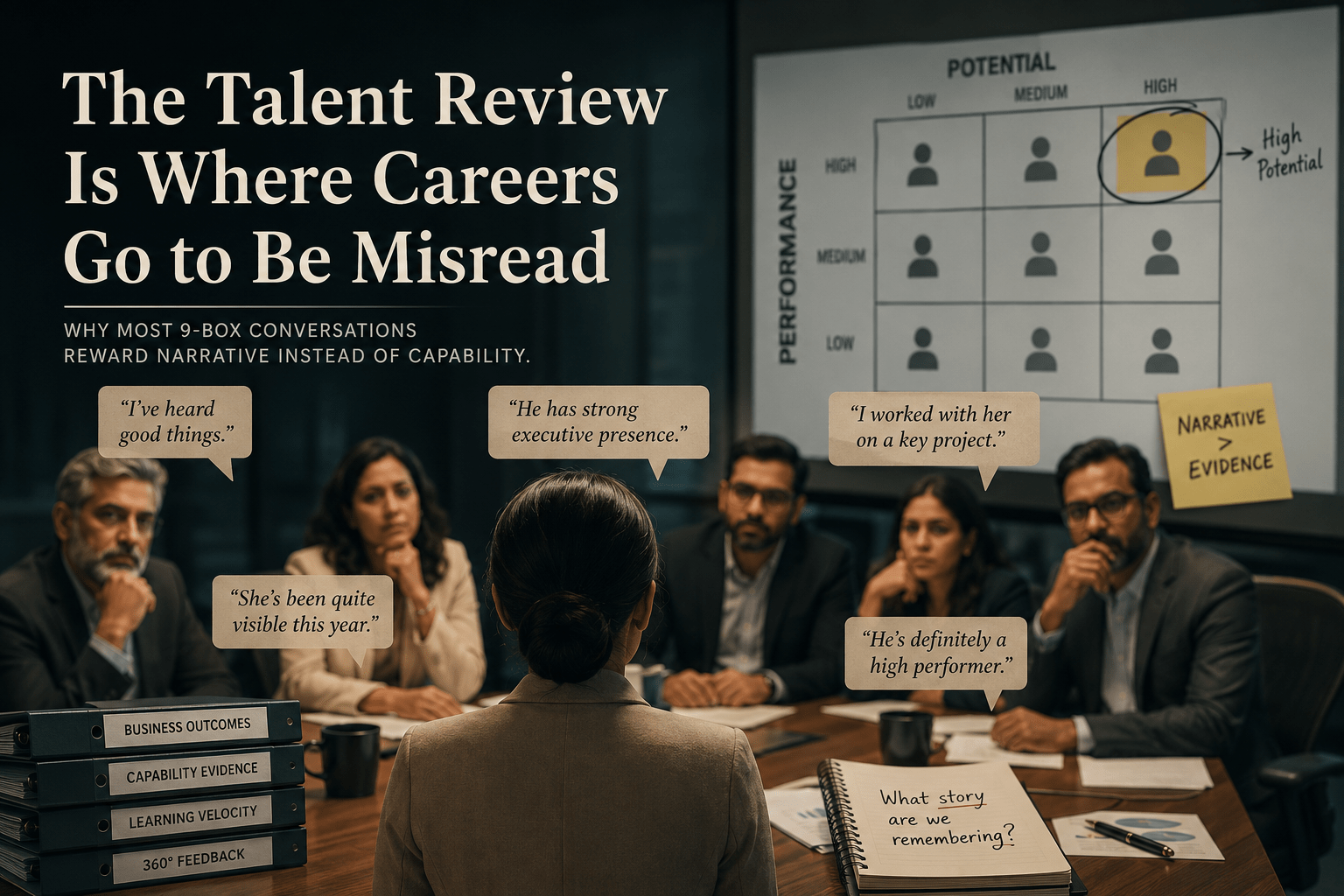
“She’s High Potential.”
The confidence has always fascinated me more than the sentence itself.
Nobody interrupts the meeting to ask what the phrase actually means. Nobody asks how the conclusion was reached. Nobody asks what evidence distinguishes “High Potential” from “Strong Performer” or “Ready Now” from “Ready Later.” The room simply accepts the statement as though someone has reported last quarter’s revenue or yesterday’s attrition number. It enters the discussion carrying the weight of an established fact rather than the uncertainty of an informed prediction.
The more succession planning discussions I have participated in over the years, the more curious I have become about that confidence.
Not because I doubt the judgement of the leaders sitting around the table. Quite the opposite. Most of these rooms are filled with experienced executives who have built businesses, led transformations and managed people for decades. If experience alone could predict future leadership, these would be the rooms where prediction should become most accurate.
And yet, these are also the rooms where I have seen the future spoken about with remarkable certainty.
Somebody says,
“He’s going to be a great business leader.”
Another adds,
“She’s definitely executive material.”
A third agrees,
“He’s one of our future CXOs.”
The discussion moves on.
The future, it appears, has already been decided.
I have often wondered whether we would speak this confidently in any other discipline.
Imagine asking an investor which startup will dominate its industry ten years from now.
Imagine asking a scientist which technology will define the next decade.
Imagine asking a meteorologist what the weather will be exactly thirty days from today.
Nobody working in those professions would confuse prediction with certainty. They would speak in probabilities, assumptions, confidence intervals and scenarios because they understand something fundamental about the future.
It cannot be measured.
It can only be anticipated.
Somewhere along the evolution of Talent Management, I suspect we quietly forgot that distinction.
We stopped treating potential as a hypothesis.
We started treating it as a diagnosis.
That shift may appear subtle, but it changes the entire philosophy of how organisations think about talent.
Performance is observable.
Potential is not.
Performance belongs to yesterday and today. It leaves behind evidence in the form of outcomes, behaviours, decisions and business impact. We can debate how well someone performed, but at least we are debating something that has already happened.
Potential belongs to tomorrow.
Tomorrow leaves no evidence.
It leaves only clues.
Yet we often discuss the two as though they belong to the same category of organisational knowledge.
They do not.
One is measurement.
The other is prediction.
The distinction matters because predictions demand humility. Measurements demand accuracy. The moment we begin confusing one for the other, our confidence grows much faster than our evidence.
Perhaps that explains why High Potential has become one of the most powerful labels in corporate life.
It opens doors.
It accelerates careers.
It attracts investment.
It determines succession pipelines.
Ironically, the label often carries greater organisational influence than the performance data that preceded it.
That is a remarkable thing when you stop to think about it.
A prediction about someone’s future can end up carrying more weight than the evidence of what they have actually accomplished.
The more I reflected on this, the more another thought began to bother me.
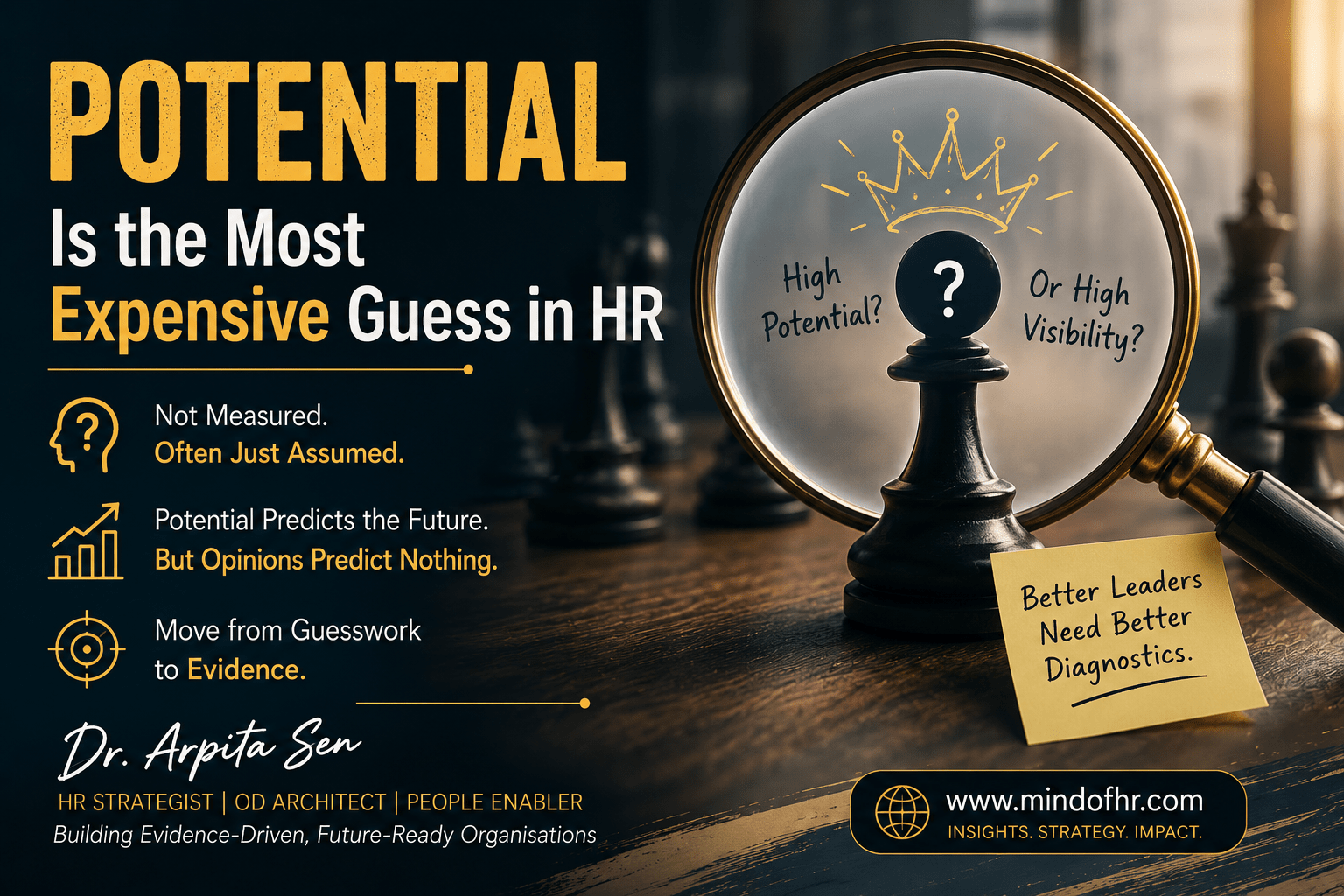
Maybe High Potential is not really a measurement at all.
Maybe it is something else entirely.
Maybe it is HR’s favourite prophecy.
The word “prophecy” sounds deliberately provocative, but stay with me for a moment.
A prophecy is not a random guess. It is an informed belief about the future based on everything we know today. It may ultimately prove correct or spectacularly wrong, but its truth cannot be verified at the moment it is spoken because the future has not yet arrived.
Is that not exactly what we do every time we identify a High Potential employee?
We are not describing a fact.
We are expressing confidence about a future that has not yet unfolded.
There is nothing inherently wrong with making those predictions. Organisations cannot build succession plans without them. Leadership pipelines would not exist if we refused to think beyond current performance.
The problem begins somewhere else.
It begins when the prediction slowly acquires the status of evidence.
Once someone has been labelled High Potential, every future success appears to validate the original judgement, while every setback is dismissed as temporary. The label starts influencing how managers interpret behaviour, allocate opportunities and even remember past performance. What began as a hypothesis quietly transforms into organisational truth.
By then, nobody remembers that it started life as an educated prediction.
Everyone remembers it as a fact.
Perhaps the real challenge in Talent Management is not that we predict the future.
It is that we become surprisingly uncomfortable admitting that we are predicting at all.
Part 2: When Opinions Learn the Language of Competencies
One of the most impressive things HR has accomplished over the last two decades is giving leadership a common language.
Competency dictionaries.
Leadership frameworks.
Behavioural indicators.
Potential models.
Learning agility.
Strategic orientation.
Enterprise thinking.
Influencing skills.
Decision quality.
These are not trivial contributions. They have helped organisations move away from vague conversations about whether someone is “good” or “not good” and towards richer discussions about observable behaviours. They have given managers a vocabulary that did not exist before.
I have designed competency frameworks myself. I have helped organisations rethink performance management systems, redefine behavioural expectations and redesign talent reviews. I have seen the value these frameworks create when they are used as intended.
Which is perhaps why I have also become increasingly aware of the trap they quietly create.
The trap is not in the framework.
It is in the confidence the framework gives us.
Consider two statements.
“I have a good feeling about her.”
“She demonstrates exceptional learning agility, strategic orientation and executive presence.”
The second statement sounds significantly more credible. It sounds researched. Structured. Objective. It carries the rhythm of professional judgement rather than personal instinct.
But has the certainty actually increased?
Or has the opinion simply become more articulate?
That question has stayed with me for years because I have noticed something curious in talent discussions.
The more sophisticated our vocabulary becomes, the less likely we are to question the judgement hiding beneath it.
Competency language has an extraordinary ability to make intuition sound measurable.
And sometimes, that is exactly what it is.
Intuition dressed in better terminology.
That does not make intuition worthless. Experienced leaders develop instincts for a reason. Years of observing people create pattern recognition that younger managers simply do not possess. The human mind is remarkably good at detecting subtle signals that are difficult to express in words.
The difficulty begins when pattern recognition quietly transforms into certainty.
Experience should strengthen judgement.
It should not eliminate doubt.
Yet many talent conversations unfold as though future leadership were already visible in today’s behaviour.
It rarely is.
Because leadership does not emerge in isolation.
It emerges in context.
A manager who thrives in a stable business may struggle in a turnaround. A functional expert who excels within a specialised team may discover that enterprise leadership demands an entirely different way of thinking. Someone who appears quiet and unassuming in one environment may become an exceptional leader once given autonomy, while another who looked destined for executive success may discover that greater authority exposes limitations that were previously hidden.
Leadership capability is remarkably sensitive to context.
Which means potential cannot possibly be a fixed attribute sitting inside an individual, waiting to be discovered through the right assessment centre or competency model.
It is an interaction.
Between the individual and the environment.
Between capability and opportunity.
Between judgement and complexity.
Between learning and experience.
That interaction keeps changing.
So should our confidence.
This is why I have always found it interesting that organisations invest enormous effort in measuring current performance but comparatively little effort in validating the predictions they make about future leadership.
Imagine if finance never reviewed the accuracy of its forecasts.
Imagine if sales teams never compared projected revenue against actual outcomes.
Imagine if demand planning stopped after producing estimates and never examined whether those estimates turned out to be correct.
No business function would accept that.
Forecasts become useful only because they are continuously tested against reality.
Talent Management rarely subjects itself to the same discipline.
We identify High Potential employees.
We accelerate their development.
We invest disproportionately in their growth.
But how often do we go back five or seven years later and ask a simple question?
How accurate were we?
Which of our predictions came true?
Which ones did not?
What patterns did we consistently overlook?
What assumptions repeatedly misled us?
Those may be the most valuable questions Talent Management can ask.
Not because they guarantee better predictions, but because they reveal whether our models are actually learning.
Perhaps this is where HR has borrowed too much from the language of diagnosis and too little from the discipline of forecasting.
A diagnosis seeks certainty about the present.
A forecast acknowledges uncertainty about the future.
Potential belongs firmly in the second category.
It is not a condition waiting to be discovered.
It is a probability waiting to be tested.
And probabilities demand something that competency frameworks alone cannot provide.
They demand evidence accumulated over time.
That realisation changed the way I began thinking about talent reviews.
Perhaps the future of succession planning is not about building more sophisticated competency models.
Perhaps it is about becoming much better students of behavioural evidence.
Not what people say during assessment centres.
Not what managers remember during calibration meetings.
But what people’s decisions, behaviours and learning trajectories quietly reveal over years rather than months.
Because while opinions become more persuasive with better vocabulary…
Evidence becomes stronger only with time.
Part 3: From Prophecy to Diagnosis
The more I have reflected on succession planning, the more I have come to believe that organisations are trying to answer the right question using the wrong discipline.
The question itself is perfectly reasonable.
“Who is most likely to become an exceptional leader?”
Every organisation needs an answer. Boards need succession pipelines. CEOs need leadership continuity. HR needs to decide where development investments should go. Talent Management cannot function without making informed predictions about the future.
The problem lies elsewhere.
It lies in how we make those predictions.
Most talent reviews still resemble conversations.
I increasingly think they should resemble investigations.
That distinction may sound semantic, but it changes everything.
A conversation is influenced by memory. An investigation is guided by evidence.
A conversation rewards confidence. An investigation rewards curiosity.
A conversation often ends when everyone agrees. An investigation ends only when the evidence becomes convincing.
The more I redesigned performance management systems over the years, the more I found myself borrowing ideas from disciplines that deal with uncertainty far better than HR traditionally has.
Medicine, for instance, rarely relies on a single observation before arriving at a diagnosis. A physician looks for convergence across multiple independent indicators. One blood test rarely settles the matter. Neither does one symptom. Confidence grows only when different pieces of evidence begin pointing in the same direction.
Talent Management deserves the same discipline.
Perhaps the question should no longer be,
“Who is High Potential?”
Perhaps it should become,
“What observable behavioural patterns consistently precede effective leadership?”
The difference between those two questions is subtle.
The first encourages labels.
The second demands evidence.
That shift also changes what we begin paying attention to.
Instead of looking for isolated moments of brilliance, organisations start looking for trajectories.
Did this individual become a better decision-maker over time?
Do they learn faster after failure than they did three years ago?
Has the complexity of the problems they solve increased consistently?
Can they influence people who do not report to them?
Do they leave teams stronger than they found them?
Do people around them become more capable because they were there?
None of these behaviours proves future leadership.
But together they leave behind something far more valuable than intuition.
They leave behind patterns.
Patterns are remarkably different from opinions.
Opinions belong to individuals.
Patterns belong to evidence.
The distinction matters because evidence accumulates while memory fades.
A manager may forget how someone handled a difficult stakeholder four years ago.
Performance records do not.
A calibration discussion may remember an impressive presentation.
Longitudinal evidence remembers hundreds of decisions made before and after that presentation.
One dramatic moment creates a story.
Repeated behaviour creates a pattern.
Leadership is almost always hidden in the second.
This is also why I have become increasingly sceptical of the annual talent review as the primary mechanism for identifying future leaders.
Leadership does not reveal itself once a year.
Neither should Talent Management.
Perhaps we have been thinking about talent reviews as events when they should really be thought of as ongoing observations.
Every project completed.
Every difficult conversation navigated.
Every decision made under ambiguity.
Every failure recovered from.
Every team strengthened.
Every unfamiliar challenge accepted.
None of these moments tells us very much on its own.
Together, they begin telling a remarkably reliable story.
Not about certainty.
About probability.
That is all succession planning has ever really been.
An attempt to improve the quality of our probabilities.
There is another consequence of recognising this.
It makes Talent Management more humble.
The strongest organisations will never be the ones that confidently declare they have identified every future leader.
They will be the ones that continuously revisit their assumptions as new evidence emerges.
Because people change.
Circumstances change.
Businesses change.
The individual who looked unremarkable at thirty-five may become exceptional at forty-two. The celebrated High Potential employee may plateau. Someone overlooked because they lacked visibility may flourish once entrusted with greater complexity.
The future has an inconvenient habit of refusing to honour our organisational labels.
That is precisely why those labels should remain hypotheses rather than verdicts.
Perhaps the purpose of Talent Management is not to predict the future perfectly.
Perhaps its purpose is to become progressively less wrong.
That is a much more achievable ambition.
And, if we are honest, a much more scientific one.
For years, organisations have invested enormous effort in making talent reviews more structured.
The next evolution, I suspect, will not come from another competency framework or another nine-box variation.
It will come from changing the philosophy altogether.
From asking less,
“Who do we believe will become a leader?”
And asking far more,
“What does the evidence consistently suggest?”
Those two questions may sound similar.
They are not.
One begins with belief.
The other begins with observation.
One seeks certainty where certainty does not exist.
The other accepts uncertainty while steadily reducing it.
That, to me, is the difference between prophecy and diagnosis.
High Potential will always remain a prediction.
There is nothing wrong with that.
The mistake begins when we convince ourselves it has somehow become a measurement simply because we have wrapped it in competency language, calibration meetings and succession frameworks.
Predictions are necessary.
Evidence is indispensable.
Wisdom lies in knowing which one we are looking at.
Because the future has never been hiding inside a competency model, waiting to be discovered.
It has always been unfolding, one behaviour, one decision and one experience at a time.
And perhaps that is the question every CHRO should carry into the next talent review.
Not,
“Who is our High Potential employee?”
But,
“If we removed every label from this discussion and looked only at the evidence accumulated over time… would we still reach the same conclusion?”
If the answer is yes, the organisation is no longer making educated guesses.
It is beginning to build a discipline.
And that may be the closest Talent Management ever comes to predicting the future without pretending that the future has already arrived.

Dr. Arpita Sen holds a bachelor’s degree in Dental Surgery (BDS) from YMT Dental College and Hospital, Navi Mumbai. She also holds an MBA in Human Resources from Narsee Monjee Institute of Management Studies (NMIMS), Mumbai, where she graduated as a double gold medallist. She is the co-author of Not a Rat Race: Success Mantras of World Athletes (2023), and Winning as Husband and Wife: Decoding the Success Mantras of Marriage (2026), co-written with Abhirup. She currently leads Learning, Organization Development, DEI, Culture, Talent and HR Strategy at a multinational organization. She writes on growth, leadership, and the future of work in her blogs, mindofhr.com and hustlerguru.com, and has been featured across several speaking platforms, podcasts and panel discussions. In her free time, she enjoys travelling, reading novels, singing and performing classical dance. She can be reached on Instagram at @authorarpitasen and on LinkedIn
Read her books:
Not a Rat Race: Success Mantras of World Atheletes
Winning as Husband and Wife: Decoding the Success Mantras of Marriage