
I still remember the ritual. Every year, around budgeting season, L&D leaders across companies would open last year’s strategy deck, stretch the timelines, add a few new competencies, and call it a three-year roadmap. It felt responsible. It felt strategic. Leadership nodded because a three-year plan signals seriousness.
Here is the uncomfortable truth I have come to accept…. that document is fiction. Not because the intent is wrong, but because the ground it stands on no longer holds still for three years.
The S-curve used to be generous
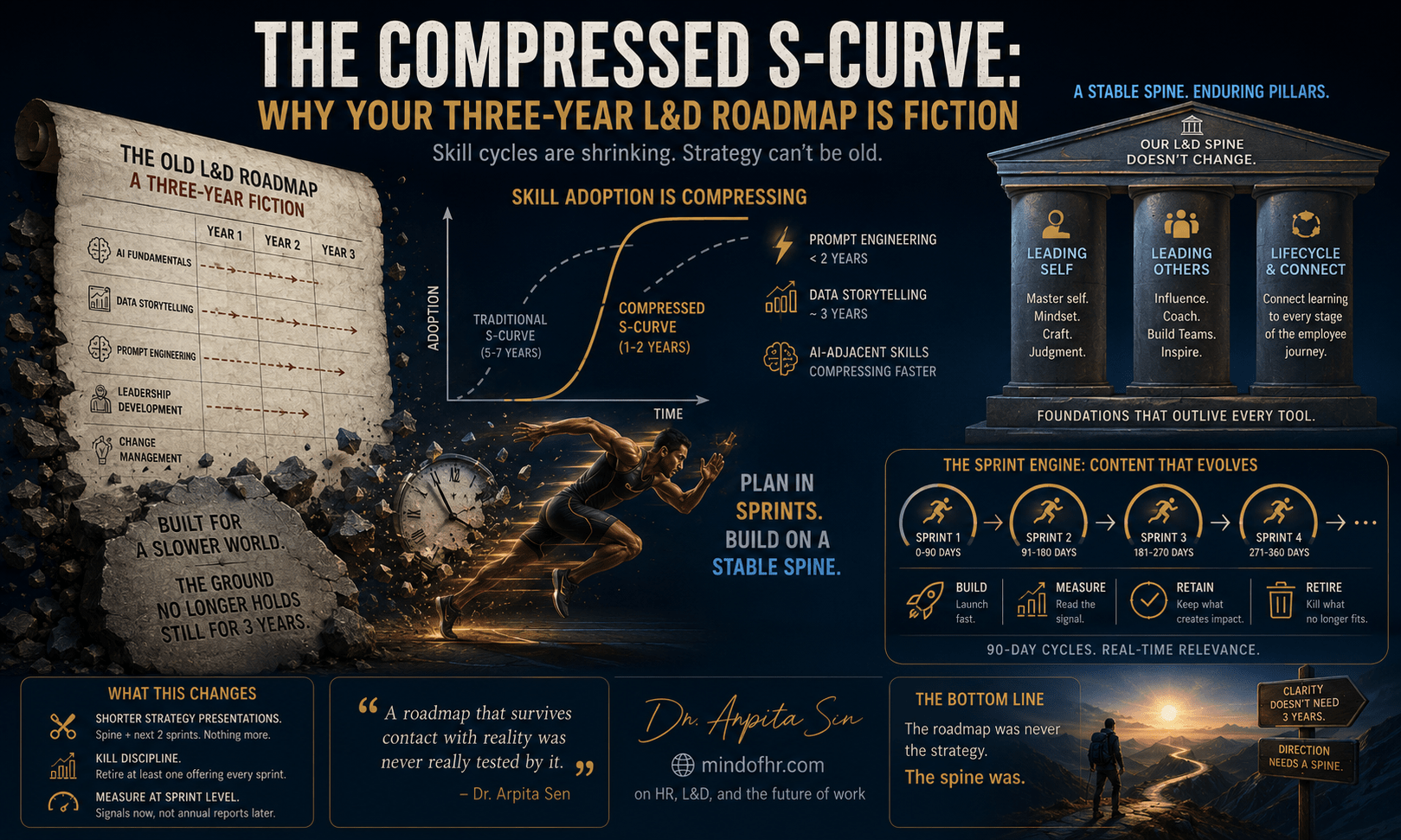
Skill adoption has always followed an S-curve. A capability emerges, early adopters experiment, the organization slowly builds fluency, the skill matures, and eventually it commoditizes. For most of my career in HR and before that in healthcare, this curve was generous. You had five to seven years to spot a skill, build a program, run cohorts, and declare victory.
Prompt engineering went from “rare superpower” to “baseline expectation” in under two years. Data storytelling took maybe three. Some AI-adjacent skills are compressing even faster…. relevant when you design the program, table stakes by the time your second cohort graduates.
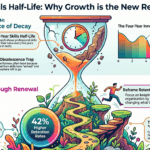
Researchers have been tracking skill half-life shrinking from roughly a decade to under five years, and for technical skills, closer to two and a half. But the number is not the point. The point is what it does to planning. When the half-life of a skill is shorter than your planning horizon, your roadmap is not a strategy. It is a museum exhibit of what mattered when you wrote it.
The trap of responding with chaos
The instinctive reaction to this is to abandon planning altogether. Run L&D like a newsroom. Chase every trending skill. Launch a GenAI workshop this quarter, an agentic AI workshop the next, and hope motion looks like progress.
I have watched functions do this. What they build is activity, not capability. Learners get whiplash. Business leaders stop trusting the calendar because it changes every review cycle. And the L&D team burns out producing content that expires before the feedback forms are analyzed.
So the answer is not a longer plan. And it is not no plan. It is a different anatomy of a plan.
Sprints on a stable spine
The architecture I have come to believe in, and one I built and ran in my own function, separates two things that most roadmaps confuse…. what changes fast and what barely changes at all.
What changes fast is content. Tools, platforms, specific technical skills, the flavor of the month in AI. This layer should be planned in sprints. Ninety-day cycles, not three-year arcs. You commit to a quarter, you deliver, you read the signal, you re-plan. If a skill compresses mid-cycle, you lose one quarter, not one strategy.
What barely changes is the spine. The enduring dimensions along which humans grow at work. In my function, this spine had three pillars…. Leading Self, Leading Others, and Lifecycle & Connect. How a person masters their own craft and mindset. How they influence, coach, and build teams. And how the organization connects learning to the actual employee journey, from the first week to the leadership table.
Notice what those pillars do not mention. No tool names. No platform. No skill that can expire. That is deliberate. The spine is where your philosophy lives. The sprints are where your relevance lives.
When I ran L&OD through a period with zero budget and a team of freshers I had trained myself, this separation was not a luxury. It was survival. We could not afford to build anything twice. The pillars stayed fixed for the full year. What rotated inside them every quarter was ruthless…. which capability academy launches, which cohort runs, which skill gets retired without ceremony. Five capability academies came up in ninety days on that logic. Not because we had resources, but because we never argued about the spine. We only argued about the sprint.
What this changes in practice
Three shifts follow from this, and each one is uncomfortable.
First, your annual L&D strategy presentation should get shorter, not longer. One slide of spine. One slide of the next two sprints. Anything beyond that is speculation dressed as rigor. As I often tell my team, “A roadmap that survives contact with reality was never really tested by it.”
Second, you need a kill discipline. Every sprint review should retire at least one offering. Compressed S-curves do not just mean skills arrive faster…. they mean skills die faster, and most L&D functions have no funeral process. The catalogue becomes a graveyard nobody visits, and the budget quietly feeds it.
Third, measurement has to move to the sprint level. If you evaluate learning impact annually, you are measuring skills that may already be obsolete. Ninety-day capability signals, however imperfect, beat twelve-month Kirkpatrick reports that arrive after the curve has moved on.
The question underneath
There is a deeper question here that most L&D leaders avoid because it feels threatening. If skill cycles keep compressing, what exactly is our function for?
My answer, after living through the compression rather than reading about it…. we are not curators of skills anymore. Skills are increasingly self-serve, AI-assisted, and cheap. What is scarce is the spine. Judgment. Influence. The ability to lead others through the same turbulence you are navigating yourself. Those do not compress. If anything, their value is rising precisely because everything around them is compressing.
So keep your three-year vision if it comforts the board. But build your actual strategy like a sprinter with a spine of steel…. quarters that move fast, pillars that do not move at all.
The roadmap was never the strategy. The spine was.

Dr. Arpita Sen holds a bachelor’s degree in Dental Surgery (BDS) from YMT Dental College and Hospital, Navi Mumbai. She also holds an MBA in Human Resources from Narsee Monjee Institute of Management Studies (NMIMS), Mumbai, where she graduated as a double gold medallist. She is the co-author of Not a Rat Race: Success Mantras of World Athletes (2023), and Winning as Husband and Wife: Decoding the Success Mantras of Marriage (2026), co-written with Abhirup. She currently leads Learning, Organization Development, DEI, Culture, Talent and HR Strategy at a multinational organization. She writes on growth, leadership, and the future of work in her blogs, mindofhr.com and hustlerguru.com, and has been featured across several speaking platforms, podcasts and panel discussions. In her free time, she enjoys travelling, reading novels, singing and performing classical dance. She can be reached on Instagram at @authorarpitasen and on LinkedIn
Read her books:
Not a Rat Race: Success Mantras of World Atheletes
Winning as Husband and Wife: Decoding the Success Mantras of Marriage