





There is a story I keep thinking about.
A mid-sized financial services firm in Mumbai was known for two things inside the industry. First, sharp quarterly numbers. Second, an HR team that was perpetually hiring. Every year, the leadership would celebrate revenue milestones in glossy town halls. And every year, quietly, somewhere between 28% and 34% of the workforce would leave.
Nobody said it aloud. But everyone in the room knew something was broken.
I have been in enough organizations to recognize that silence. It is not the silence of contentment. It is the silence of people who have decided that speaking up is not worth the cost.
The question I want to sit with today is not a new one. But it is one that deserves a more honest, more evidence-grounded answer than it usually gets.
Do organizations that treat people poorly actually pay the price?
Or is that just something HR people say to feel better?
The Data Is Not Gentle
Let me start with what the numbers say, because the numbers are remarkably consistent.
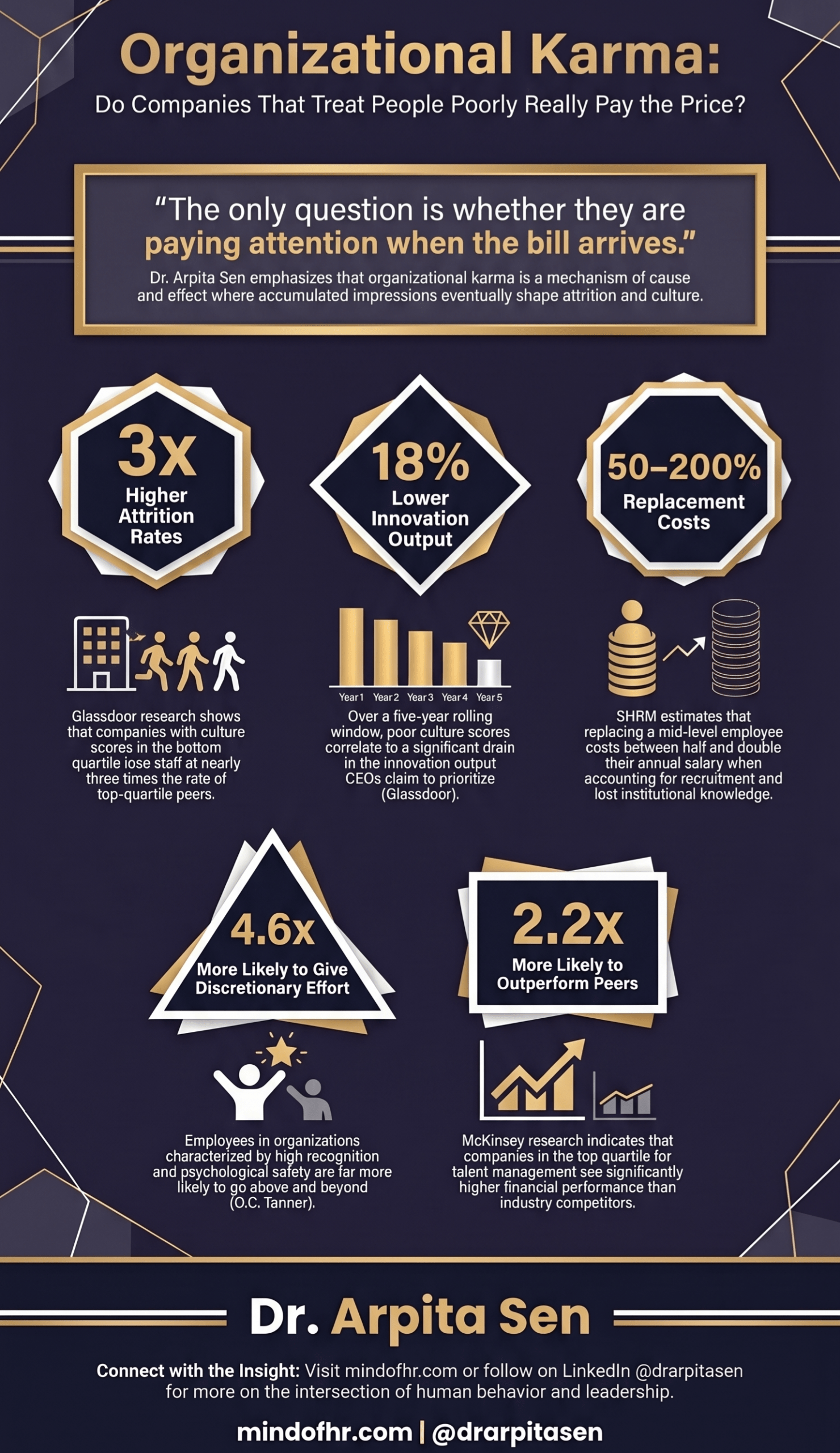
Glassdoor’s research across a decade of culture reviews and financial performance data shows that companies with culture scores in the bottom quartile have attrition rates nearly three times higher than those in the top quartile. Three times. Not marginally higher. Not slightly elevated. Three times.
The same dataset points to something even more uncomfortable for business leaders who believe culture is a soft metric. Companies with poor culture scores show 18% lower innovation output over a five-year rolling window. Innovation, the thing every CEO claims they want more of, quietly drains away in environments where people do not feel safe, valued, or seen.
The O.C. Tanner Institute’s 2023 Global Culture Report studied over 36,000 employees across 20 countries. It found that employees in organizations with high recognition and psychological safety are 4.6 times more likely to give discretionary effort – the kind of effort that moves organizations forward in ways that are almost impossible to quantify in a job description.
Discretionary effort. The extra hour someone stays not because they must but because they want to. The idea they share in a hallway conversation that becomes a product. The junior colleague someone mentors because the culture made them feel it mattered.
That is what leaves when culture breaks. Quietly, invisibly, long before the resignation letter arrives.
Karma Is Not a Metaphor. It Is a Mechanism.
I want to be precise here, because I think this word – karma – often gets used loosely, and it deserves better.
In Vedic philosophy, karma is not about punishment or reward in some cosmic courtroom. It is about consequence arising from action. Cause and effect, operating not always immediately, but inevitably. Every action generates an impression. Impressions accumulate. Accumulated impressions shape what comes next.
Organizations operate by the same principle.
When a leader shouts at a team member in a public setting, the immediate victim is one person. But the invisible victims are everyone who witnessed it. Something shifts in that room. A decision is made by observers – not consciously, but below the surface – about how safe this place actually is. That decision shapes behavior. Behavior shapes outcomes. Outcomes shape culture. Culture shapes attrition.
The karma is not instant. That is why leaders who behave poorly often don’t connect their workforce exits to their own conduct. The lag between cause and consequence creates the illusion that the two are unrelated.
They are not.
The Real Cost That Never Appears in the P&L
Here is something that rarely gets said in board meetings.
The Society for Human Resource Management (SHRM) estimates that replacing a mid-level employee costs between 50% to 200% of their annual salary when you account for recruitment, onboarding, lost productivity during the learning curve, and the institutional knowledge that walks out the door with them.
But that is only the direct cost.
The indirect cost is harder to measure and far more damaging. When high performers leave, they do not leave quietly. They leave with relationships. They leave with clients they were quietly managing. They leave with insights into product gaps that never made it to the strategy deck. And sometimes, they leave with the two or three people they hired and mentored, who no longer see a reason to stay either.
The original departure triggers a cascade. And the cascade rarely appears in any attrition analysis because organizations measure headcount, not momentum.
McKinsey’s research on organizational health shows that companies in the top quartile for talent management are 2.2 times more likely to outperform their industry peers financially. This is not correlation without mechanism. The mechanism is simple. Good people attract good people. Treated well, they stay long enough to build something. Staying long enough, they accumulate the institutional wisdom that actually creates competitive advantage.
The inverse is equally true. And equally inevitable.
The Story That Stayed With Me
Pierre Teilhard de Chardin once wrote that we are not human beings having a spiritual experience. We are spiritual beings having a human experience.
I read that line differently now than when I first encountered it. In the context of organizational life, it means something specific to me.
When a person walks into a workplace, they do not leave their humanity at the entrance. They carry their need for dignity, for recognition, for meaning. They carry their capacity for loyalty, for brilliance, for generosity. How that humanity is received… shapes everything that follows.
Organizations that honor the humanity of their people receive something that cannot be manufactured or mandated. Commitment. The kind that does not need monitoring. The kind that does not require a performance improvement plan to activate.
Organizations that diminish that humanity receive something too. Compliance, at best. Quiet subversion, at worst. And eventually, absence – first of imagination, then of the person.
This is karma. Not as philosophy. As organizational physics.
What This Means for Leaders
The leaders I respect most are not the ones who have never made mistakes. They are the ones who understand that how they show up – in difficult conversations, in ambiguous situations, in moments of pressure – is not just a personal choice. It is an organizational investment or an organizational debt.
Every act of dignity compounds. Every act of dismissal compounds too.
The evidence is clear. The philosophy is consistent. And the lived experience of anyone who has spent time inside organizations confirms both.
So the answer to the question I started with?
Yes. Companies that treat people poorly do pay the price.
The only question is whether they are paying attention when the bill arrives.
About the Author:

Dr. Arpita Sen is Lead – Learning & Organization Development and Head – Diversity, Opportunity & Inclusion at Hitachi Payment Services. She writes on the intersection of human behavior, organizational culture, and leadership. Follow her on LinkedIn @drarpitasen or read more at mindofhr.com

Dr. Arpita Sen holds a bachelor’s degree in Dental Surgery (BDS) from YMT Dental College and Hospital, Navi Mumbai. She also holds an MBA in Human Resources from Narsee Monjee Institute of Management Studies (NMIMS), Mumbai, where she graduated as a double gold medallist. She is the co-author of Not a Rat Race: Success Mantras of World Athletes (2023), and Winning as Husband and Wife: Decoding the Success Mantras of Marriage (2026), co-written with Abhirup. She currently leads Learning, Organization Development, DEI, Culture, Talent and HR Strategy at a multinational organization. She writes on growth, leadership, and the future of work in her blogs, mindofhr.com and hustlerguru.com, and has been featured across several speaking platforms, podcasts and panel discussions. In her free time, she enjoys travelling, reading novels, singing and performing classical dance. She can be reached on Instagram at @authorarpitasen and on LinkedIn
Read her books:
Not a Rat Race: Success Mantras of World Atheletes
Winning as Husband and Wife: Decoding the Success Mantras of Marriage