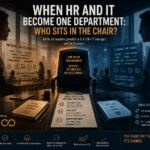



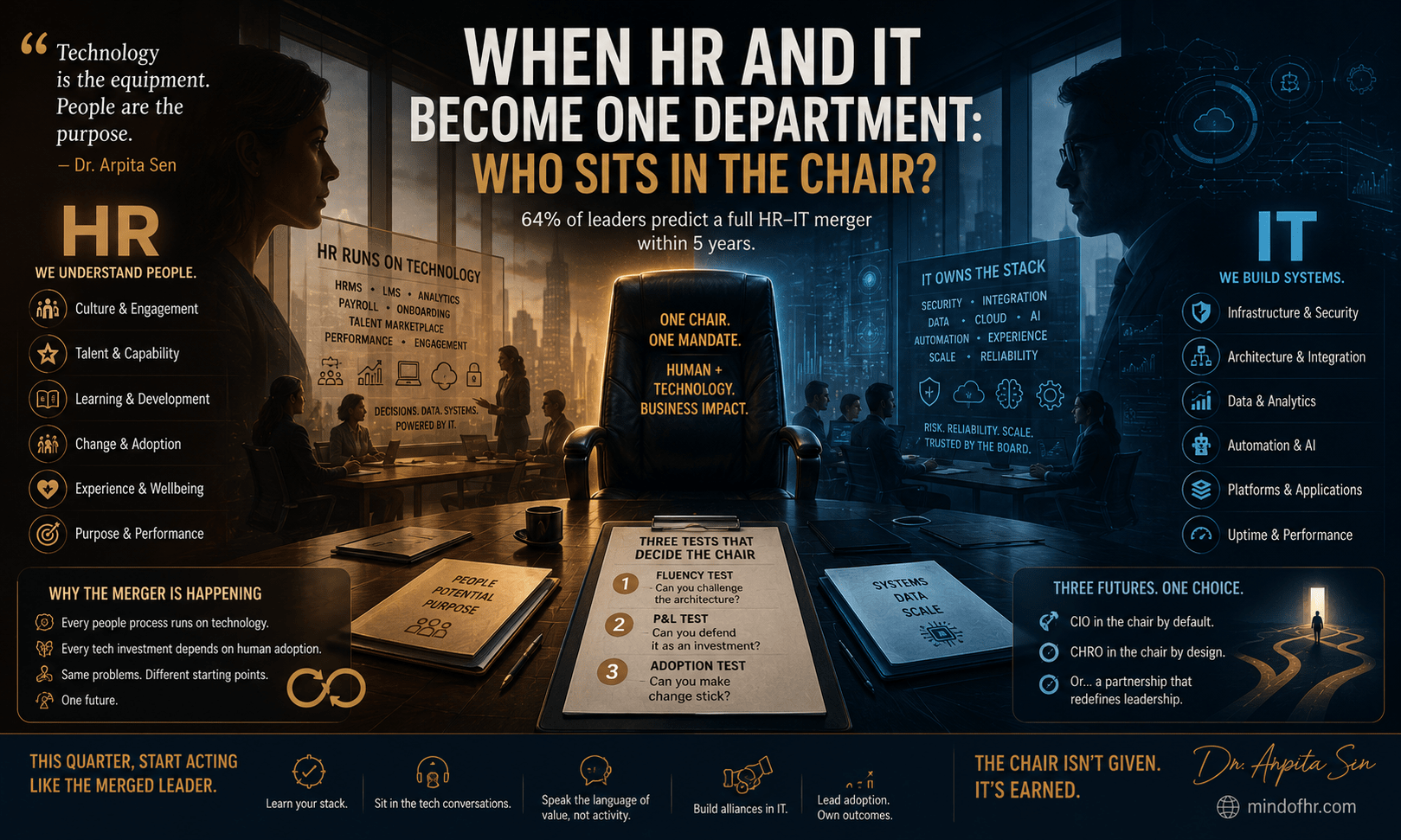
There is a number floating around leadership circles right now…. 64% of leaders predict a full HR-IT merger within five years.
Most people who read that stat nod, file it under “interesting,” and move on. I could not move on. Because hidden inside that prediction is a question nobody in HR is asking out loud.
If the two functions become one department…. who sits in the chair? Does the CHRO absorb the CIO, or does the CIO absorb the CHRO?
Sit with that for a moment. Because your answer decides whether the next decade of your career is an ascent or a slow demotion dressed up as “transformation.”
Why this merger is already happening quietly
Nobody will send a memo announcing that HR and IT have merged. It is happening transaction by transaction.
Think about what HR actually runs on today. Your HRMS decides how work flows. Your LMS decides how people grow. Your analytics stack decides whose performance story gets told and whose gets buried. Payroll, onboarding, engagement surveys, talent marketplaces…. every single one is a technology decision wearing an HR costume.
I have sat through enough HRMS and LMS evaluations to see the pattern up close. The vendor demos to HR, but the real decision-making questions…. integration architecture, data ownership, API depth, security posture…. get answered by IT. HR states the requirement. IT holds the veto.
Now flip the lens. What is IT increasingly accountable for? Adoption. Digital experience. Change fatigue. AI readiness of the workforce. Every one of those is a human problem wearing a technology costume.
The two functions are not merging because a consultant said so. They are merging because their problems already have.
The uncomfortable truth about who wins by default
Here is the part most HR readers will not enjoy.
If this merger happens on autopilot, the CIO wins. Not because technologists are smarter, but because of how organizations assign credibility. IT speaks in uptime, cost, and risk…. the native language of the boardroom. HR still too often speaks in engagement scores and training hours, which the board translates as “nice.”
When a merged function forms, the chair goes to whoever the CEO trusts to run a system, not a sentiment. And right now, in most companies, that trust sits with the CIO.
I will say it plainly, because someone has to.
“HR has spent twenty years outsourcing its technology thinking to IT, and it is about to pay for that convenience with the corner office.” …. Dr. Arpita Sen
Every time an HR leader said “I’m not a tech person” in a systems meeting, they were signing a small piece of their future authority away. The bill is now arriving.
The case for the CHRO taking the chair
And yet…. I do not believe the CIO is the natural owner of this merged function. I believe the CHRO is. But only a specific kind of CHRO.
Here is my logic. Technology is becoming easier to buy and harder to adopt. Any two competitors can license the same HRMS, the same AI copilots, the same analytics platform within a quarter. The technology itself is no longer the differentiator. What differentiates is whether three thousand humans actually change how they work because of it.
That is not a systems integration problem. That is a behaviour problem. A trust problem. A capability problem. And behaviour, trust, and capability are HR’s home turf…. or at least they are supposed to be.
I come to this from an unusual angle. I trained as a doctor before I moved into HR, and clinical thinking never leaves you. A hospital does not put the equipment vendor in charge of the patient. It puts the physician in charge and expects her to understand the equipment deeply. The machine serves the diagnosis, never the other way around.
The merged HR-IT function is the same. The “patient” is organizational capability. The technology is the equipment. The chair should belong to the leader who owns the diagnosis…. provided she can also read the machine.
That last clause is where most CHRO ambitions will quietly die.
The three tests that decide the chair
Strip away the politics and I think the chair goes to whoever passes three tests.
The fluency test. Can you sit in a vendor negotiation and challenge the architecture, not just the price? A CHRO who cannot ask a hard question about data models will be managed by her own reports.
The P&L test. Can you defend this merged function as an investment with returns, not a cost with justifications? The leader who frames people-technology spend in revenue and risk language owns the conversation.
The adoption test. Can you make change actually stick? This is the one CIOs routinely fail…. beautiful implementations, empty log-ins. It is also the one HR leaders are best positioned to win, because adoption is culture, and culture has always been our territory.
Notice something. Two of these three tests favour a technologically fluent CHRO. None of them favour a people-blind CIO. The chair is HR’s to lose.
And most of HR is currently losing it.
What this means for you, this quarter
If you lead HR at any level, stop waiting for the merger announcement. Start behaving like the merged leader now.
Learn your own stack the way a doctor learns her instruments. Sit in on IT architecture reviews even when you are not invited…. especially when you are not invited. Translate your next initiative into cost, risk, and revenue before anyone asks. Build one genuine friendship with a senior technologist and trade fluency for fluency.
The 64% prediction is not a threat. It is the clearest career signal HR has received in a generation. A single chair is being built right now, in budget meetings and platform decisions you are probably skipping.
Someone will sit in it within five years.
The only real question is whether HR shows up to that meeting as the physician…. or as the patient.
What is your take…. does the CHRO absorb the CIO, or the reverse? I want to hear the argument I have not thought of yet.

Dr. Arpita Sen holds a bachelor’s degree in Dental Surgery (BDS) from YMT Dental College and Hospital, Navi Mumbai. She also holds an MBA in Human Resources from Narsee Monjee Institute of Management Studies (NMIMS), Mumbai, where she graduated as a double gold medallist. She is the co-author of Not a Rat Race: Success Mantras of World Athletes (2023), and Winning as Husband and Wife: Decoding the Success Mantras of Marriage (2026), co-written with Abhirup. She currently leads Learning, Organization Development, DEI, Culture, Talent and HR Strategy at a multinational organization. She writes on growth, leadership, and the future of work in her blogs, mindofhr.com and hustlerguru.com, and has been featured across several speaking platforms, podcasts and panel discussions. In her free time, she enjoys travelling, reading novels, singing and performing classical dance. She can be reached on Instagram at @authorarpitasen and on LinkedIn
Read her books:
Not a Rat Race: Success Mantras of World Atheletes
Winning as Husband and Wife: Decoding the Success Mantras of Marriage