






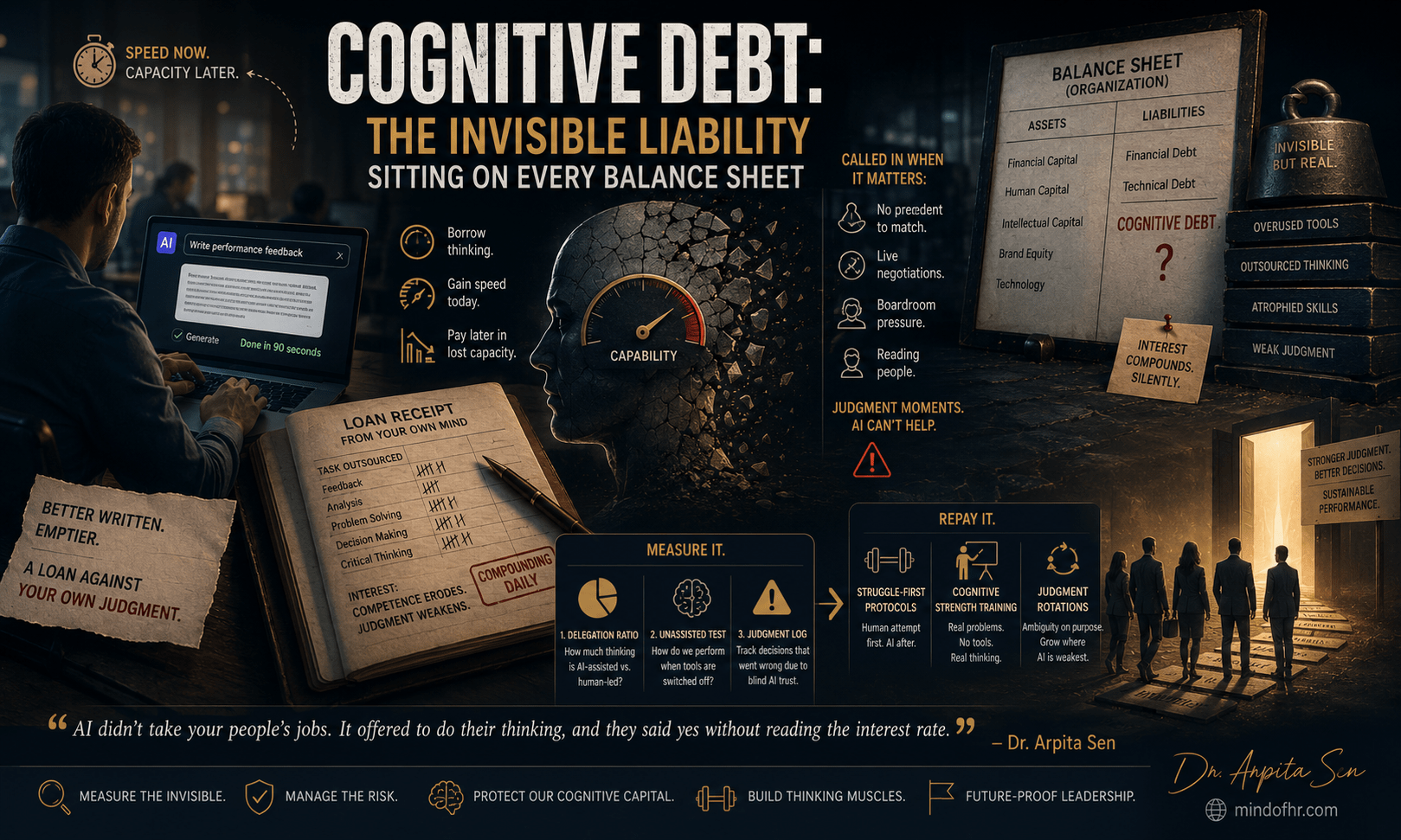
Last month I watched a manager write performance feedback for his team. Except he did not write it. He typed three bullet points into an AI tool, got back four polished paragraphs, changed one word, and hit send. The whole exercise took ninety seconds. Six months ago, that same feedback would have taken him forty minutes of actual thinking… recalling incidents, weighing patterns, choosing words that would land without wounding.
The feedback he sent was better written. It was also emptier. And here is the part nobody in that room registered: he just took a small loan against his own judgment. He will take another one tomorrow. So will thousands of employees across your organization, every single day, and no function is keeping the ledger.
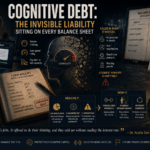
I am calling this Cognitive Debt. And I believe it belongs on the same shelf as financial debt and technical debt… except it is the only one of the three that nobody is tracking.
What Cognitive Debt actually is
Every CFO can tell you the company’s debt-to-equity ratio. Every CTO worth their title can point to the legacy code that will cost millions to refactor someday. Both functions understand the same principle: borrowing gives you speed now in exchange for capacity later, and the interest compounds quietly until it does not.
Cognitive Debt works the same way. Every time an employee outsources a thinking task to AI that they could have done themselves, the organization gains speed and loses a repetition. One repetition means nothing. But skills are not stored, they are maintained. A muscle you stop using does not stay at its current strength waiting for you… it atrophies on a schedule.
I trained as a dentist before I moved into HR, and clinical education taught me something corporate L&OD forgot: competence lives in repetition under consequence. A surgeon who watches a hundred procedures is not a surgeon. In my current role I see the corporate equivalent everywhere. Analysts who can prompt a market summary but can no longer build one. Managers who can generate feedback but can no longer diagnose the behavior underneath it. First-drafts that no longer exist because nobody drafts anymore, they only edit.
The debt is invisible because output quality goes up while capability quietly goes down. Your dashboards measure the output. Nothing measures the capability. That gap is the liability.
When the debt gets called
Debt is fine until the creditor knocks. Cognitive Debt gets called in exactly the moments that matter most:
The crisis where AI has no precedent to pattern-match. The negotiation happening live in a room. The board question that arrives without warning. The moment a leader must read a person, not a document. These are judgment moments, and judgment is precisely the muscle the organization stopped exercising three years earlier because the tool was faster.
Here is my staked position: within five years, the companies that fail will not fail because they adopted AI too slowly. They will fail because they adopted it without a repayment plan, and discovered mid-crisis that their leadership bench could execute but could no longer think.
How L&OD measures it
If cognitive debt is real, it needs a metric, because what gets a number gets a budget. Three measurements any L&OD function can start this quarter:
The Delegation Ratio. For each critical role, map the top five thinking tasks and estimate what percentage is now AI-assisted versus human-led. A role where 80 percent of analytical work runs through a tool is a role accruing debt at 80 percent. You do not need surveillance software for this… a well-designed self-audit plus manager calibration gets you a defensible baseline in a month.
The Unassisted Performance Test. Once or twice a year, put people in scenarios where the tools are switched off. A case simulation, a live problem-solving assessment, a whiteboard diagnosis. Compare unassisted performance against the same cohort’s assisted output. The gap between the two numbers is your cognitive debt, expressed in a way a CFO instantly understands: this is what we own versus what we have borrowed.
The Judgment Incident Log. Track decisions that went wrong specifically because a human accepted an AI output without interrogating it. Most organizations already have these incidents. They are just filed under “process error” instead of what they actually are… interest payments on cognitive debt.
How L&OD repays it
Repayment is not banning tools. That is like repaying financial debt by refusing revenue. Repayment is deliberate, scheduled cognitive load:
Struggle-first protocols. For developmental tasks, the human attempt comes before the AI assist, not after. Draft first, then compare. Diagnose first, then verify. The AI becomes a sparring partner instead of a substitute. This single sequencing change preserves the repetition while keeping the speed.
Cognitive strength training. Regular, tool-free sessions on live business problems. Not case studies from 2015… this quarter’s actual dilemmas, worked in rooms, on whiteboards, out loud. When I built capability academies from scratch on zero budget, the highest-impact sessions were always the ones with the least material and the most thinking. Poverty of resources forces wealth of cognition. Design that deliberately.
Judgment rotations. Put high-potentials into ambiguity on purpose… a negotiation, a crisis simulation, a stakeholder conflict with no playbook. AI is weakest exactly where humans grow fastest: incomplete information, live emotion, competing truths.
A Cognitive Debt line in the annual capability review. Report it to the board next to attrition and engagement. The moment it appears in a governance document, it stops being a philosophy and becomes a managed risk.
The quiet question
Financial debt shows up in audits. Tech debt shows up in outages. Cognitive debt shows up in the one place no dashboard reaches… the quality of the decision your leaders make on the day the tools cannot help them.
As I often say in my sessions: “AI did not take your people’s jobs. It offered to do their thinking, and they said yes without reading the interest rate.”
Your company knows exactly how much money it owes. Ask your CHRO how much thinking it owes.
Nobody has that number yet. The first HR function that does will own the conversation.

Dr. Arpita Sen holds a bachelor’s degree in Dental Surgery (BDS) from YMT Dental College and Hospital, Navi Mumbai. She also holds an MBA in Human Resources from Narsee Monjee Institute of Management Studies (NMIMS), Mumbai, where she graduated as a double gold medallist. She is the co-author of Not a Rat Race: Success Mantras of World Athletes (2023), and Winning as Husband and Wife: Decoding the Success Mantras of Marriage (2026), co-written with Abhirup. She currently leads Learning, Organization Development, DEI, Culture, Talent and HR Strategy at a multinational organization. She writes on growth, leadership, and the future of work in her blogs, mindofhr.com and hustlerguru.com, and has been featured across several speaking platforms, podcasts and panel discussions. In her free time, she enjoys travelling, reading novels, singing and performing classical dance. She can be reached on Instagram at @authorarpitasen and on LinkedIn
Read her books:
Not a Rat Race: Success Mantras of World Atheletes
Winning as Husband and Wife: Decoding the Success Mantras of Marriage