






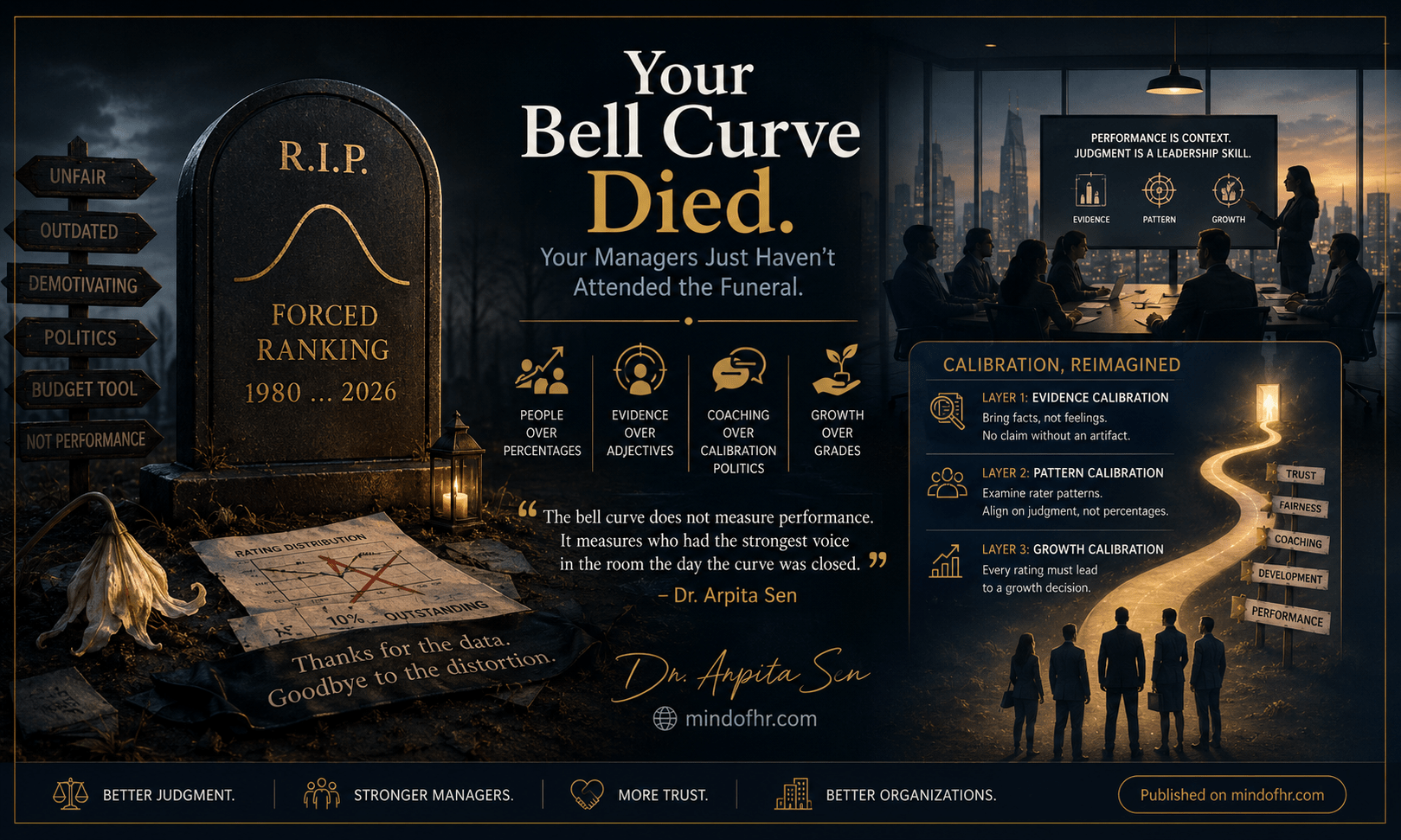
Every appraisal season, somewhere in a conference room in Mumbai or Bengaluru or Gurgaon, a manager is fighting for a rating. Not for a person… for a rating. The employee’s actual work stopped mattering forty minutes ago. What matters now is the distribution sheet on the screen, the one that says only 10 percent of the team can be “outstanding,” and the quiet arithmetic of who gets sacrificed to make the curve close.
I have sat in these rooms. I have run these rooms. And I will say plainly what most HR leaders say only over coffee… the bell curve is dead, and everyone knows it, and we keep performing the ritual anyway.
The logic collapsed years ago
Forced ranking made sense in a world it no longer describes. It assumed large, stable teams doing comparable work, where performance genuinely spread across a normal distribution. That world is gone. Today’s teams are small, cross-functional, and lopsided by design. A six-member team building something new does not produce a bell curve. It produces two or three people carrying disproportionate load, and forcing them into a distribution is not statistics… it is fiction with a spreadsheet.
Microsoft dropped stack ranking in 2013. Adobe killed annual ratings and watched voluntary attrition fall. GE, the company that gave the world “rank and yank,” walked away from its own invention. The research caught up too… forced distribution rewards visibility over contribution, punishes strong teams for being strong, and teaches your best people that the safest career move is joining a weak team.
So why does it survive in Indian companies, a full decade after its architects abandoned it?
Why the corpse still walks here
Three honest reasons, and none of them are about performance.
First, the bell curve is a budgeting tool wearing a performance costume. Forced distribution exists to cap the bonus pool. That is its real job. As long as increments are funded as a fixed percentage of payroll, someone in finance will defend the curve, because the curve is what makes the math close. We should at least stop pretending this is about meritocracy.
Second, it protects managers from the hardest conversation in management. A distribution lets a manager say “I fought for you, but the system forced my hand.” The curve becomes a shield. Remove it, and managers must own their judgment out loud, with evidence, to the employee’s face. Most of our managers have never been trained for that conversation, so we keep the shield.
Third, hierarchy loves the curve. Forced ranking concentrates power at the moment of calibration. Whoever controls the room controls the narrative, and in many Indian organizations, calibration is where politics gets laundered into ratings. The loudest sponsor wins. The quiet performer with no godfather absorbs the “adjustment.” I have watched careers bend in those forty minutes… and rarely because of the work.
“The bell curve does not measure performance. It measures who had the strongest voice in the room the day the curve was closed.” … Dr. Arpita Sen
What I built instead: calibration in three layers
When I redesigned a performance system from scratch, I refused to start with distribution. I started with a different question… what is calibration actually for? If the answer is “to make the budget close,” you get a curve. If the answer is “to make our judgment about people more accurate and our coaching more honest,” you get something else entirely.
Here is the three-layer model I designed.
Layer 1: Evidence calibration. Before any manager enters a room, they submit evidence, not adjectives. What did this person deliver against their goals? What changed because they existed in this role this year? The rule is simple… no claim without an artifact. This single discipline kills 60 percent of calibration politics, because vague praise and vague criticism both die when asked for proof. The manager who says “attitude problem” must now show what happened, when, and what feedback was given at the time. Most cannot. That tells you something.
Layer 2: Pattern calibration. This is the peer layer… managers of comparable functions sit together and look for patterns, not rankings. Is one manager rating everyone high because they avoid conflict? Is another rating everyone low because they confuse harshness with standards? The conversation here is about the raters, not just the rated. Rating behavior is a leadership behavior, and this is where it gets examined. No forced percentages… but full visibility of how each manager’s distribution compares, with the burden of explanation, not adjustment.
Layer 3: Growth calibration. The final layer asks the only question that makes any of this worth the effort… what does each person need next? A stretch role, a skill investment, a candid course correction, a new manager, an exit with dignity. Every rating must exit this room attached to a coaching decision. A rating with no development consequence is just a label, and labels do not grow people.
Notice what is missing. There is no moment where a name gets moved down a list to satisfy a percentage. Differentiation still happens… it happens naturally, through evidence, and it is sharper than any curve because it can survive being explained to the employee’s face.
The real funeral
Here is what I have come to believe. The bell curve does not survive in Indian companies because leaders think it works. It survives because burying it requires three things we underinvest in… managers who can judge, managers who can converse, and HR leaders willing to tell finance that a performance system is not a cost-control instrument.
The companies that figure this out will not just have better appraisals. They will have something rarer… employees who believe the system saw them.
The curve is already dead. The only question is how many more careers we bury with it before we hold the funeral.

Dr. Arpita Sen holds a bachelor’s degree in Dental Surgery (BDS) from YMT Dental College and Hospital, Navi Mumbai. She also holds an MBA in Human Resources from Narsee Monjee Institute of Management Studies (NMIMS), Mumbai, where she graduated as a double gold medallist. She is the co-author of Not a Rat Race: Success Mantras of World Athletes (2023), and Winning as Husband and Wife: Decoding the Success Mantras of Marriage (2026), co-written with Abhirup. She currently leads Learning, Organization Development, DEI, Culture, Talent and HR Strategy at a multinational organization. She writes on growth, leadership, and the future of work in her blogs, mindofhr.com and hustlerguru.com, and has been featured across several speaking platforms, podcasts and panel discussions. In her free time, she enjoys travelling, reading novels, singing and performing classical dance. She can be reached on Instagram at @authorarpitasen and on LinkedIn
Read her books:
Not a Rat Race: Success Mantras of World Atheletes
Winning as Husband and Wife: Decoding the Success Mantras of Marriage