




I was sitting in an HRMS evaluation a couple of years ago when a vendor said the sentence that eventually became this article.
We were deep into the demo. I asked how their screening algorithm ranked candidates…. what data it learned from, what it penalised, what it quietly rewarded. The salesperson smiled and said, “Ma’am, that is all handled at our end. You don’t have to worry about it.”
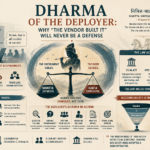
That sentence is designed to feel like a gift. It is actually a transfer of risk, dressed as a courtesy.
Because here is what happens eighteen months later. The tool rejects a category of candidates at a strange rate. Or nudges appraisal ratings in a direction nobody chose. Or surfaces “flight risk” scores that managers start treating as verdicts. Someone asks the CHRO how this happened. And the answer “the vendor built it” lands in the room with all the weight of a wet tissue.
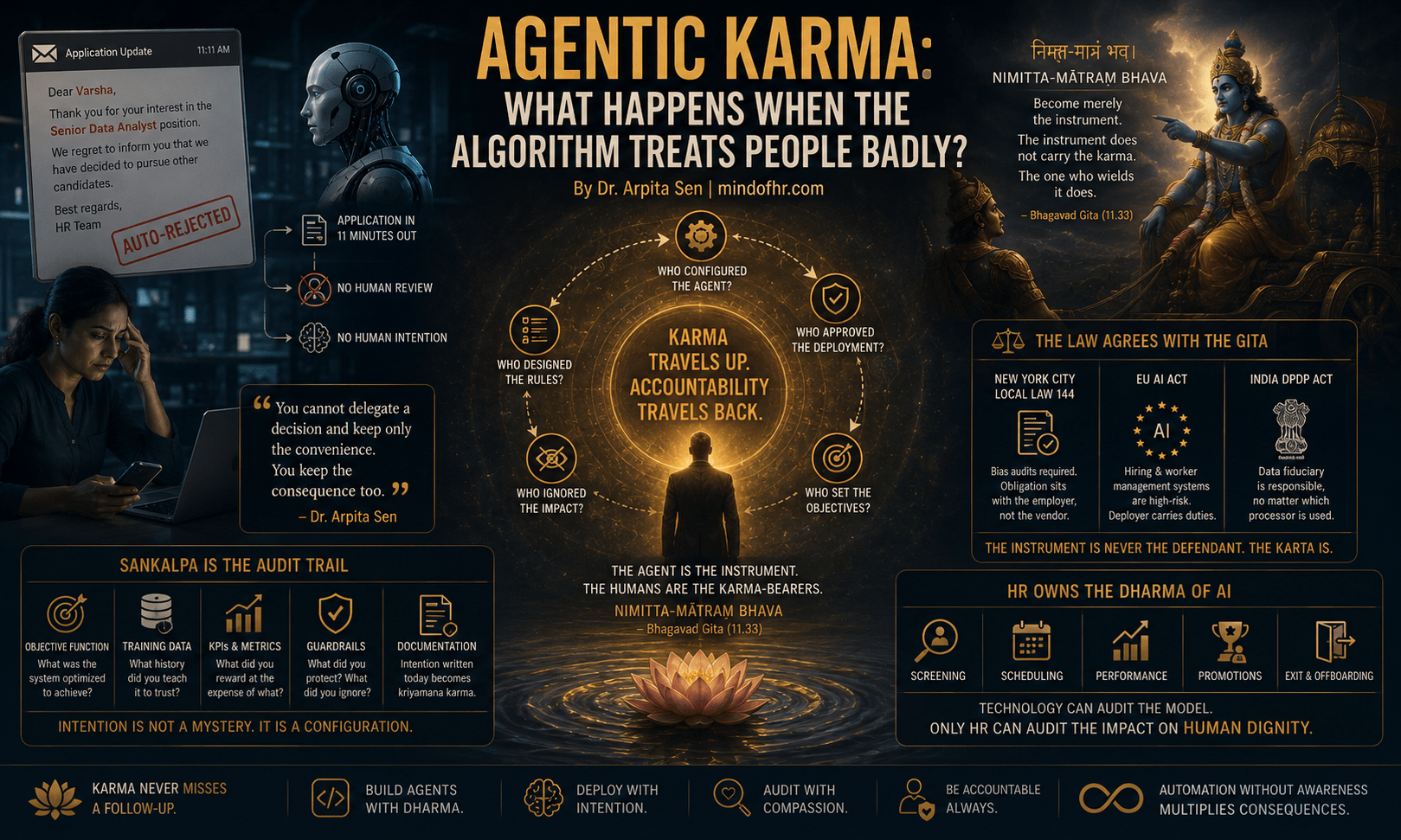
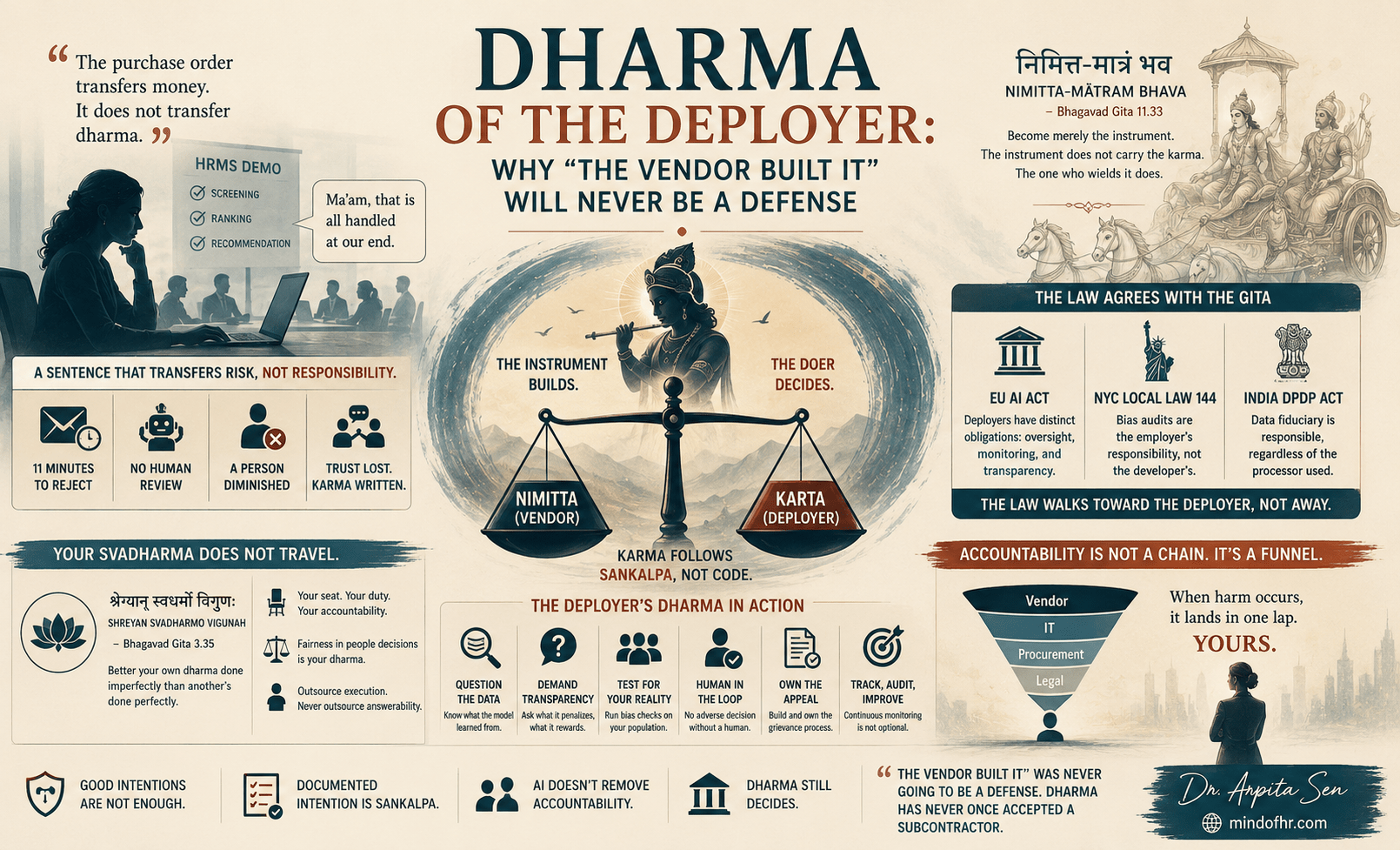
Regulators have already made up their minds on this. The EU AI Act does not only regulate the companies that build AI systems…. it places distinct obligations on deployers, the organisations that use them. Human oversight, monitoring, informing affected people. New York’s Local Law 144 goes further and puts the bias audit obligation on the employer using the hiring tool, not the developer who coded it. The direction is unmistakable. The law is walking toward the deployer, not away.
But I don’t think we need regulation to tell us this. Our own tradition settled the question a few thousand years ago.
Svadharma does not travel with a purchase order
Svadharma is one of the most misunderstood ideas we have exported to corporate vocabulary. It is not “passion” or “calling.” It is duty that attaches to your position…. duty you carry because of the seat you occupy, not the tasks you personally perform.
The Gita is blunt about its non-transferability. Shreyan svadharmo vigunah…. better your own dharma done imperfectly than another’s done perfectly. The verse is usually read as career advice. Read it instead as accountability doctrine. Your duty remains yours even when someone else could execute it better, cheaper, faster. Especially then.
The CHRO’s svadharma is fairness in people decisions. Who gets hired, who gets rated, who gets promoted, who gets exited. That dharma existed before AI and it survives AI completely intact. When an algorithm now sits inside those decisions, the dharma does not migrate to the algorithm’s maker. The seat has not changed. Only the instrument has.
I said this to a colleague recently and I will stand by it here: “The purchase order transfers money. It does not transfer dharma.”
The vendor is the nimitta. You are the karta.
There is a verse in the eleventh chapter that most people quote in the wrong direction. Nimitta-matram bhava…. be merely the instrument. Krishna says it to Arjuna about the war.
In the AI accountability chain, look at who is actually the nimitta. The vendor built a capability. A general-purpose thing, like a sword-smith forging steel. The vendor did not decide to point it at your workforce. You did. Your evaluation committee did. Your signature did.
In our joint family tradition, the karta is the one who manages the family’s affairs and answers for them…. to the family, to creditors, to the law. The karta can take advice from anyone. The karta can delegate execution to everyone. What the karta cannot do is delegate answerability. When the family’s decisions cause harm, nobody accepts “my munim suggested it” as a defense.
The CHRO who deploys an AI system into people decisions is the karta of that deployment. The sankalpa…. the deciding intent…. was yours. Karma-phala follows sankalpa, not code. The vendor wrote the model. You wrote the decision to use it on human beings who trusted your organisation with their careers.
What the deployer’s dharma actually looks like
I have sat through enough HR tech evaluations now, from HRMS platforms to LMS and LXP demos, to know that the dharma of the deployer is not abstract. It shows up as specific, slightly uncomfortable behaviours in specific rooms.
It looks like asking the vendor what data the model was trained on, and not accepting “proprietary” as a complete sentence. It looks like demanding that the demo show you a wrong answer, not just the highlight reel. It looks like running your own bias check on your own population before go-live, because the vendor’s benchmark population is not your workforce. It looks like insisting that no adverse decision…. rejection, rating, exit flag…. is final without a human who can be named. It looks like owning the appeal process yourself, because an employee cannot file a grievance with an API.
Every one of these makes the procurement cycle longer. Every one of these makes you the difficult stakeholder in the room. That discomfort is not a bug. That discomfort is the dharma being performed.
The final karta
Here is the uncomfortable arithmetic of AI in HR. The vendor holds the model. IT holds the integration. Procurement holds the contract. Legal holds the clauses. And yet when a candidate is wrongly screened out, or an employee is wrongly scored, the injury lands in exactly one function’s lap.
Ours.
Which means the accountability chain in AI is not really a chain. It is a funnel. Everything narrows to the person who decided this system would touch human careers. The Gita never promised Arjuna that outsourcing the moment would dissolve the karma of it. It told him the opposite…. you are in the seat, so act, and own the acting.
The organisations that internalise this will build slower, ask harder questions, and sign fewer glossy contracts. They will also be the ones still standing when the first wave of AI employment litigation arrives in India, the way it already has elsewhere.
“The vendor built it” was never going to be a defense. Dharma has never once accepted a subcontractor.

Dr. Arpita Sen holds a bachelor’s degree in Dental Surgery (BDS) from YMT Dental College and Hospital, Navi Mumbai. She also holds an MBA in Human Resources from Narsee Monjee Institute of Management Studies (NMIMS), Mumbai, where she graduated as a double gold medallist. She is the co-author of Not a Rat Race: Success Mantras of World Athletes (2023), and Winning as Husband and Wife: Decoding the Success Mantras of Marriage (2026), co-written with Abhirup. She currently leads Learning, Organization Development, DEI, Culture, Talent and HR Strategy at a multinational organization. She writes on growth, leadership, and the future of work in her blogs, mindofhr.com and hustlerguru.com, and has been featured across several speaking platforms, podcasts and panel discussions. In her free time, she enjoys travelling, reading novels, singing and performing classical dance. She can be reached on Instagram at @authorarpitasen and on LinkedIn
Read her books:
Not a Rat Race: Success Mantras of World Atheletes
Winning as Husband and Wife: Decoding the Success Mantras of Marriage