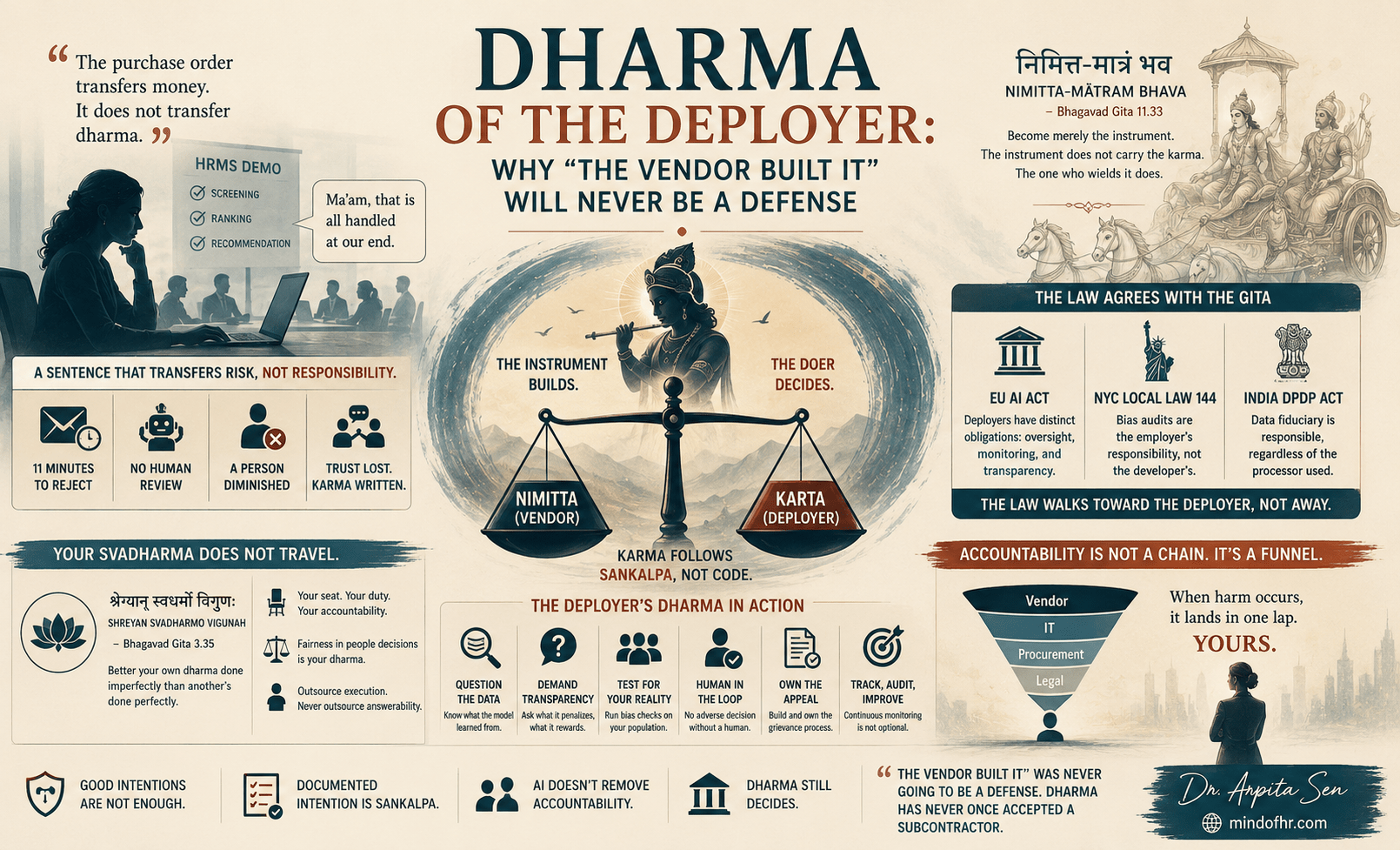

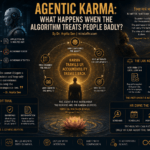


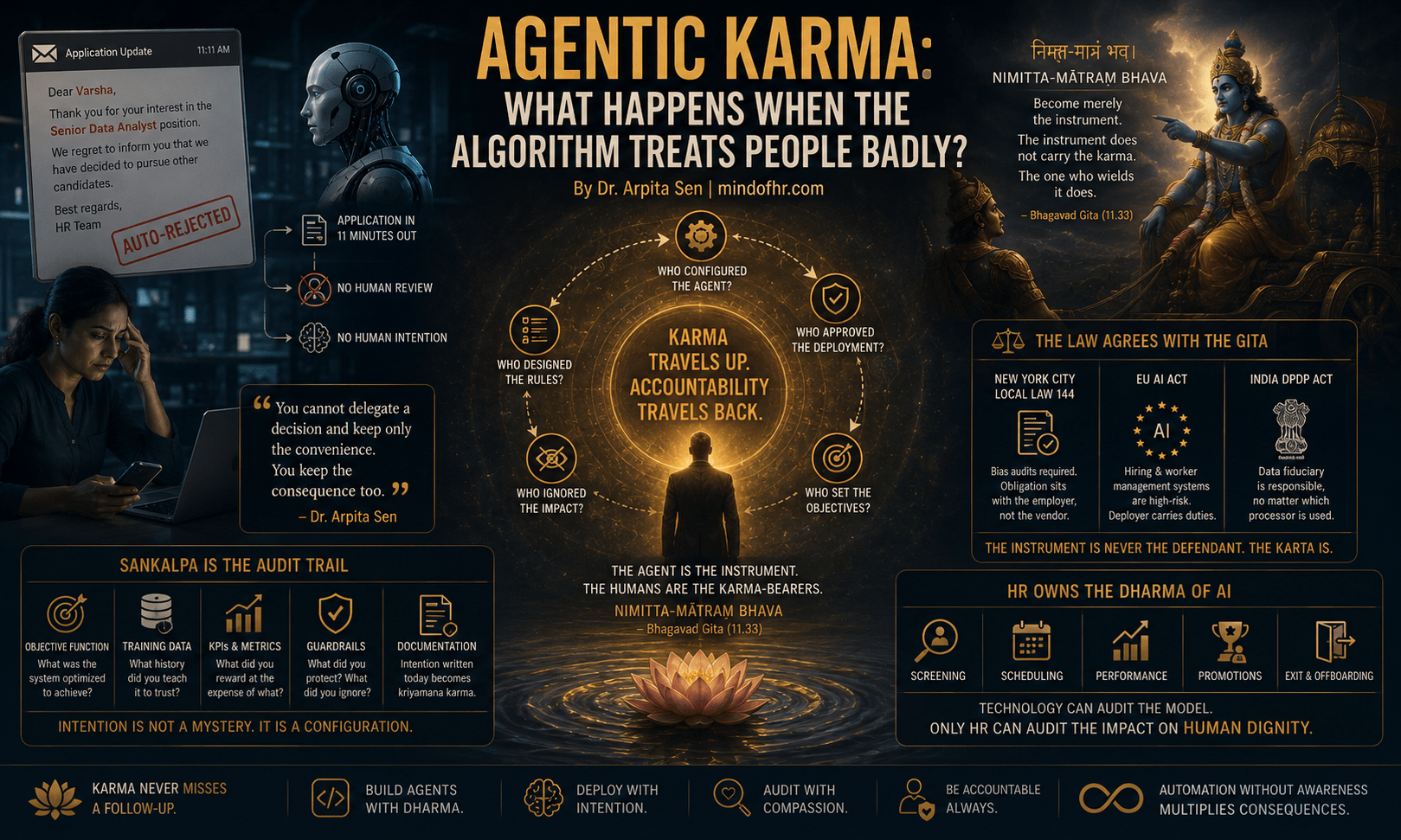
A friend of mine applied to a large tech company last year. She spent four hours on the application. Eleven minutes after submitting, she received a rejection. Not a polite one. A cold, auto-generated line that misspelled her name and thanked her for her interest in a role she had not applied for.
No human saw her CV. No human wrote that email. No human decided anything.
And yet something happened in that moment. A person was diminished. Trust was withdrawn. A story about that company was written in her mind, and she has told it at least thirty times since…. including to me, which is why you are reading it now.
So here is the question I have been sitting with. If karma is the moral residue of action, and the action was performed by an agent with no soul, no intention, and no awareness…. where does the karma go?
Karma needs a karta
When I wrote about Organizational Karma, my argument was simple. Organizations accumulate consequences the way individuals do. Every layoff handled with dignity, every promotion decided on merit, every exit interview actually listened to…. these deposits compound. So do the withdrawals.
But that framework assumed something we took for granted. A doer. In Sanatan thought, karma is inseparable from the karta. Action without an actor is not karma, it is just motion. A river flooding a village carries no karma. A landlord who ignored the warnings and built there anyway carries all of it.
The Gita has a phrase for this that I keep returning to. Krishna tells Arjuna, nimitta-mātraṁ bhava…. become merely the instrument. The instrument does not carry the karma. The one who wields it does.
Now read that again with an AI agent in mind.
The recruiting agent that rejected my friend was nimitta. An instrument. The karma did not vanish because a machine performed the action. It travelled backwards, up the chain, to whoever configured the agent, whoever approved its deployment, whoever decided that eleven-minute rejections were an acceptable trade for efficiency…. and whoever chose not to read the rejection letter template even once.
This is the uncomfortable truth of agentic AI. Automation does not dissolve accountability. It concentrates it.
The law already agrees with the Gita
What fascinates me is that modern regulation is arriving at the same conclusion the rishis did, just in duller language.
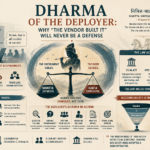
New York City’s Local Law 144 requires bias audits for automated employment decision tools, and the obligation sits with the employer, not the vendor. The EU AI Act classifies hiring and worker management systems as high-risk, and again, the deployer carries duties it cannot outsource. India’s DPDP Act holds the data fiduciary responsible regardless of which processor or algorithm touched the data.
Different jurisdictions, one principle. The instrument is never the defendant. The karta is.
Which means when an AI agent nudges an employee onto a PIP based on productivity signals that never accounted for her caregiving leave, the legal exposure does not sit inside the model weights. It sits with the CHRO who signed off on the system, the HR ops leader who fed it the data, and the manager who accepted its recommendation without a single clarifying question.
As I often say in my sessions…. “You cannot delegate a decision and keep only the convenience. You keep the consequence too.”
Sankalpa is the audit trail
Sanatan Dharma makes one more distinction that AI governance desperately needs. Karma is weighted by sankalpa…. intention. The same action carries different moral loads depending on the intent behind it.
Translate that into enterprise language and you get something surprisingly practical. The intention behind an AI system is not a mystery. It is documented. It lives in the objective function, the training data choices, the KPIs the system was optimized for, the guardrails that were funded and the ones that were deprioritized in the last sprint.
If your candidate-screening agent was optimized purely for time-to-reject, your sankalpa is on record. If your performance agent was trained on historical ratings from a period everyone privately admits was politically contaminated, your sankalpa is on record. Regulators will call it documentation. I call it kriyamana karma being written in real time, one configuration file at a time.
This is why “the algorithm did it” will never survive as a defense, legally or morally. The algorithm did nothing. It executed a sankalpa that humans encoded, approved, and profited from.
HR is about to own this, whether it wants to or not
Here is my staked position. AI governance in the enterprise will not ultimately live with the CIO or the legal team. It will live with HR.
Because look at where agentic AI is actually touching human lives first. Screening. Scheduling. Performance signals. Promotion recommendations. Attrition prediction. Exit processing. Every one of these is an HR process. Every rude rejection, every unfair nudge, every biased ranking is an HR outcome wearing a technology costume.
Technology teams can audit the model. Only HR can audit the dharma of the process…. whether the action, performed at scale and at speed, still treats a human being the way that human deserves to be treated.
That requires a new capability in our function. Not prompt engineering. Judgment engineering. HR leaders who can read an objective function the way they read a policy document, and ask the question no dashboard will surface…. what does this system do to the dignity of the person on the other side of it?
I built two functions from scratch in environments where I had no budget and no playbook. What I learned is that when nobody owns a consequence, the consequence still arrives. It just arrives without a manager.
Agentic karma works the same way. Deploy a thousand agents, and you have not distributed your accountability. You have multiplied your karta-ship a thousand times.
The organizations that understand this will write intention into their systems the way they write values onto their walls. The ones that do not will discover that karma, unlike their agents, never misses a follow-up.

Dr. Arpita Sen holds a bachelor’s degree in Dental Surgery (BDS) from YMT Dental College and Hospital, Navi Mumbai. She also holds an MBA in Human Resources from Narsee Monjee Institute of Management Studies (NMIMS), Mumbai, where she graduated as a double gold medallist. She is the co-author of Not a Rat Race: Success Mantras of World Athletes (2023), and Winning as Husband and Wife: Decoding the Success Mantras of Marriage (2026), co-written with Abhirup. She currently leads Learning, Organization Development, DEI, Culture, Talent and HR Strategy at a multinational organization. She writes on growth, leadership, and the future of work in her blogs, mindofhr.com and hustlerguru.com, and has been featured across several speaking platforms, podcasts and panel discussions. In her free time, she enjoys travelling, reading novels, singing and performing classical dance. She can be reached on Instagram at @authorarpitasen and on LinkedIn
Read her books:
Not a Rat Race: Success Mantras of World Atheletes
Winning as Husband and Wife: Decoding the Success Mantras of Marriage