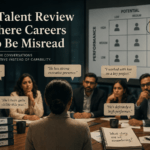




Why most 9-box conversations reward organisational memory instead of organisational evidence.
The first time I sat through a talent calibration discussion, I walked into the room with a quiet confidence that now feels almost naive.
I had spent days preparing what I believed was the right material for a serious conversation about people. There were performance outcomes, project impact, behavioural evidence, stakeholder feedback, development milestones, capability assessments and enough data points to convince myself that we were about to have something resembling a diagnostic discussion. After all, if this meeting was going to influence promotions, succession pipelines and future leadership opportunities, surely the conversation would revolve around evidence.
It did not.
Within the first fifteen minutes, I realised that the room was operating on an entirely different currency.
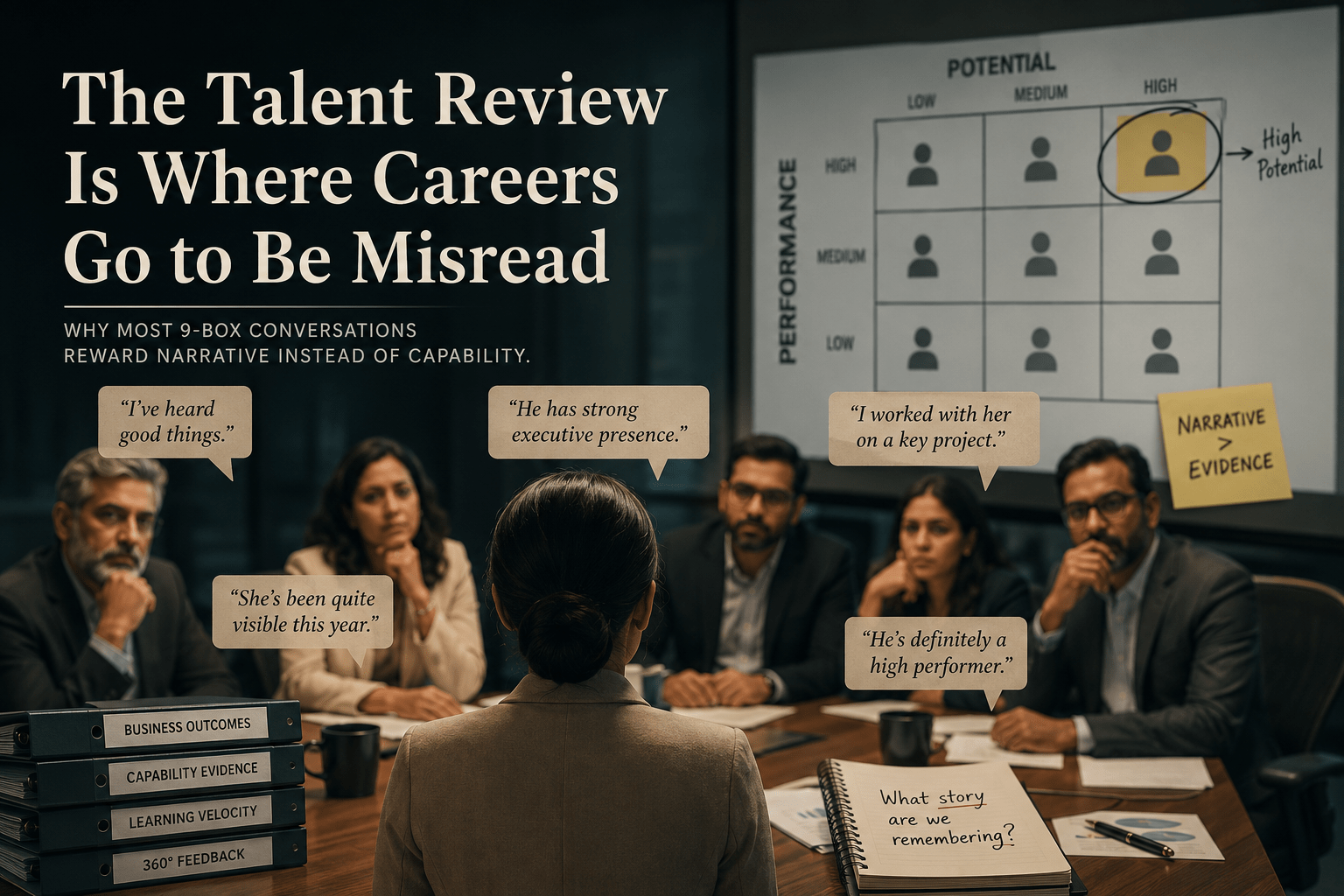
Someone’s name appeared on the screen, and before anyone opened a performance report or referred to a competency assessment, the conversation had already begun taking shape.
“She’s one of our strongest leaders.”
“I’ve heard very good things about him.”
“She’s become very visible this year.”
“I worked with him on that strategic initiative. He’s excellent.”
None of these statements were necessarily incorrect. In fact, many of them probably reflected genuine experiences. But what struck me was how quickly individual recollections became collective truth. Once the room settled on a narrative, every subsequent piece of information seemed to organise itself around protecting that narrative rather than testing it.
I remember leaving that discussion with an uncomfortable thought that has stayed with me through every performance management redesign I have worked on since.
Perhaps talent reviews are not really evaluating talent.
Perhaps they are evaluating what the organisation collectively remembers about talent.
There is an important difference between those two ideas, and I suspect it explains why so many capable people spend years wondering why their careers seem to move more slowly than the quality of their work would suggest.
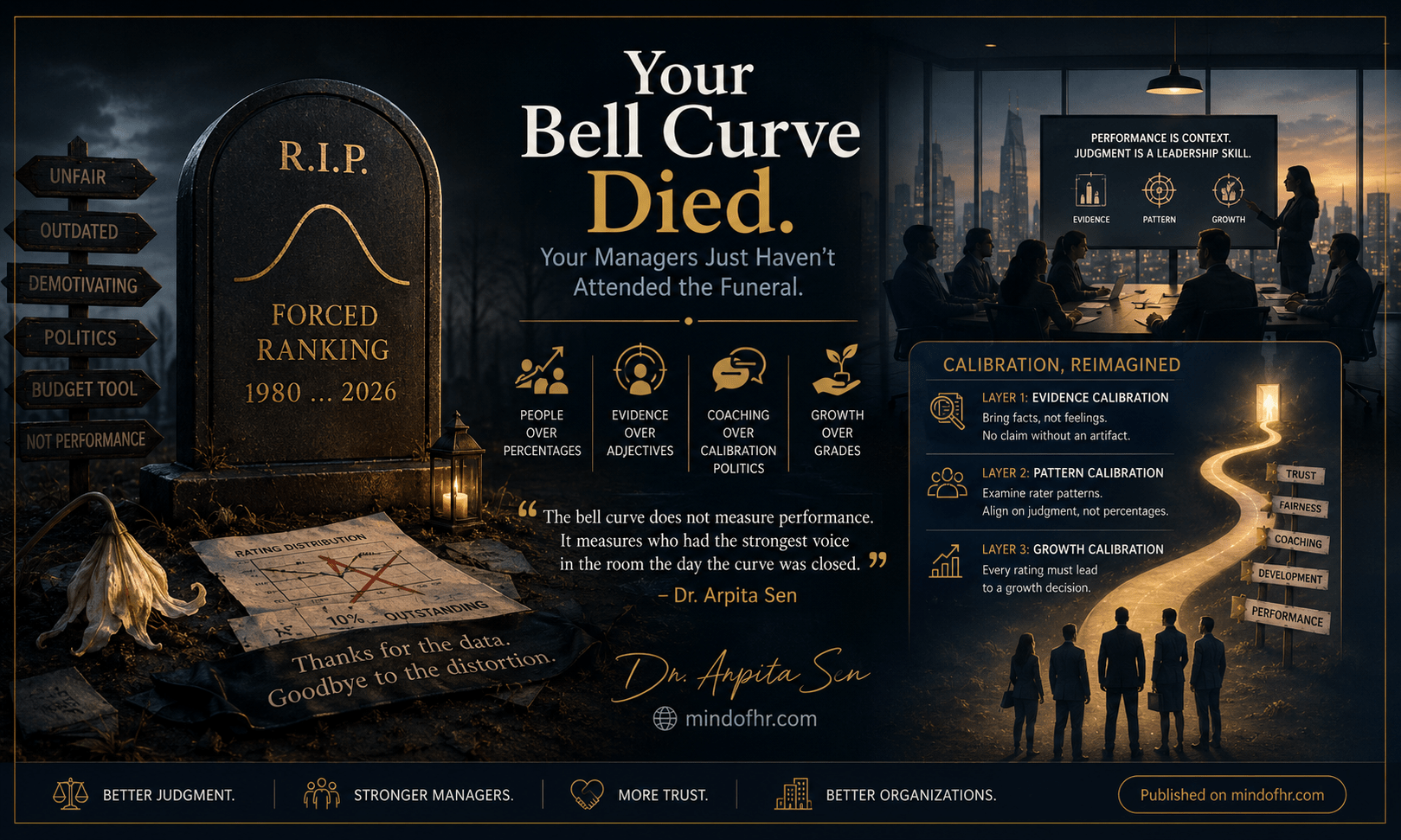
Most organisations believe that their talent review process is designed to reduce subjectivity. We create competency frameworks, define potential indicators, build nine-box matrices, introduce calibration meetings and encourage managers to support their ratings with examples. The architecture appears rigorous, and on paper it certainly looks more objective than asking a single manager to decide someone’s future.
Yet every one of these frameworks still depends on one fragile input. The conversation.
And conversations are deeply imperfect instruments of measurement.
Unlike financial audits or quality inspections, talent reviews rarely begin with evidence and move towards conclusions. More often, they begin with conclusions and spend the rest of the meeting searching for evidence that makes those conclusions feel justified. The first description of an employee quietly anchors the room, and every subsequent observation is interpreted through that lens. Psychology has explained this phenomenon for decades through concepts like anchoring bias and confirmation bias, but we continue to treat calibration discussions as though they exist outside the laws of human cognition.
They do not.
If anything, they amplify them.
One question has continued to bother me over the years.
Why do some exceptionally capable individuals remain consistently underrated while others seem to develop reputations that travel ahead of their actual contribution?
I no longer think the answer lies entirely in performance.
I think it lies in visibility.
Or perhaps, more accurately, in organisational recall.
There is a category of employee that every organisation quietly depends upon. They rarely present in town halls. They are not always leading the highest-profile projects. They do not possess the instinct for executive self-marketing that modern organisations often reward. What they do possess is extraordinary execution. They solve problems before they become crises. They simplify processes that nobody else wanted to untangle. They coach colleagues without seeking recognition and create stability that only becomes visible after they leave.
Ironically, the better these individuals become at preventing problems, the fewer memorable stories the organisation accumulates about them.
Their excellence is experienced.
It is rarely narrated.
By contrast, there are employees whose work naturally generates visibility. They lead transformation programmes, present before senior leadership, participate in strategic committees or simply communicate with greater confidence. Their contribution may indeed be significant, but it also benefits from something equally valuable. It is easier to remember.
And memory has always enjoyed an unfair advantage over measurement.
This is why I have gradually stopped thinking of calibration meetings as evaluation exercises. They are, in many organisations, exercises in organisational storytelling. Every manager walks into the room carrying a narrative about their people. Those narratives compete, reinforce one another, evolve through discussion and eventually crystallise into ratings, succession plans and high-potential lists. By the time the meeting concludes, the organisation feels as though it has assessed capability. More often than not, it has simply selected the most persuasive story.
The nine-box itself is not the problem.
Like every good management framework, it was designed with thoughtful intent. Separating current performance from future potential is an intellectually sound idea, and organisations should absolutely distinguish between sustained execution and long-term leadership capacity. The difficulty begins when potential itself becomes a narrative rather than a diagnosis.
Potential slowly starts meaning the person senior leaders already know.
The person whose confidence is mistaken for readiness.
The person whose visibility is mistaken for influence.
The person whose story has travelled farther than their evidence.
That is not a failure of the framework.
It is a failure of the conversation taking place inside it.
While redesigning performance management systems over the past few years, I found myself borrowing an analogy from medicine rather than management. A physician does not diagnose a patient by asking everyone in the hospital what they remember about them. She examines multiple forms of evidence, looks for patterns across independent observations, questions inconsistencies and only then arrives at a conclusion. The credibility of the diagnosis depends not on the authority of the doctor but on the quality of the evidence supporting it.
Talent reviews deserve the same discipline.
Imagine a calibration discussion where every employee enters the room with a diagnostic profile rather than a managerial narrative. Business outcomes would still matter, but they would sit alongside learning agility, decision quality under ambiguity, behavioural consistency, complexity handled, capability growth over time and evidence of strengthening others around them. The conversation would become slower, less theatrical and considerably more difficult to politicise because opinions would have to compete with observable patterns rather than with one another.
That, to me, is what a mature talent review should aspire to become.
Not a room where the most compelling storyteller wins.
But a room where the strongest diagnosis emerges.
The question every organisation should ask after a talent review is not whether leaders reached agreement. Agreement is remarkably easy to manufacture when the room shares the same assumptions.
The more uncomfortable question is this.
If another leadership team, unfamiliar with these employees but given exactly the same evidence, would they reach broadly the same conclusions?
If the answer is yes, the organisation has probably built a robust talent system.
If the answer is no, then the organisation has built something else entirely.
It has built a memory system that mistakes familiarity for capability and narrative for potential.
Careers deserve better than that.
Because the greatest failure of a talent review is not that it occasionally overlooks a high performer. Every organisation will make those mistakes from time to time.
The greater failure is far more subtle.
It is teaching an entire workforce that the path to recognition lies not only in doing exceptional work, but in ensuring that exceptional work survives the long journey from execution to memory.
The day performance becomes secondary to recollection is the day talent reviews stop discovering future leaders.
They merely confirm the leaders the organisation had already decided to notice.

Dr. Arpita Sen holds a bachelor’s degree in Dental Surgery (BDS) from YMT Dental College and Hospital, Navi Mumbai. She also holds an MBA in Human Resources from Narsee Monjee Institute of Management Studies (NMIMS), Mumbai, where she graduated as a double gold medallist. She is the co-author of Not a Rat Race: Success Mantras of World Athletes (2023), and Winning as Husband and Wife: Decoding the Success Mantras of Marriage (2026), co-written with Abhirup. She currently leads Learning, Organization Development, DEI, Culture, Talent and HR Strategy at a multinational organization. She writes on growth, leadership, and the future of work in her blogs, mindofhr.com and hustlerguru.com, and has been featured across several speaking platforms, podcasts and panel discussions. In her free time, she enjoys travelling, reading novels, singing and performing classical dance. She can be reached on Instagram at @authorarpitasen and on LinkedIn
Read her books:
Not a Rat Race: Success Mantras of World Atheletes
Winning as Husband and Wife: Decoding the Success Mantras of Marriage